
Wide aisles in warehouse operations have long been the standard layout. Incorporating broad access routes, lined with pallet racking, they allow for safe forklift movement, efficient picking, and high-volume traffic. Wide aisles have been the foundation of warehouse design for decades.
But the industry faces very different demands today. In modern operations, sock volumes continue to grow, fulfilment demands more speed, and inventory profiles are changeable. These operations are under much greater pressure, and for many, extra floorspace isn’t a viable option. However, a reassessment of the existing space can help identify opportunities to use the space more efficiently. A key focus is often the space between racking runs, and whether is could be used more effectively. This raises a valid question:
Could aisle width be reduced to increase storage capacity?
For many operations, the answer is yes. Tighter spacing between each run of racking makes far better use of available floor space. But the process is more involved than simply moving the racks closer together. It requires careful planning to ensure targeted modifications that prioritise productivity, accessibility, and safety, together with maximising storage capacity.
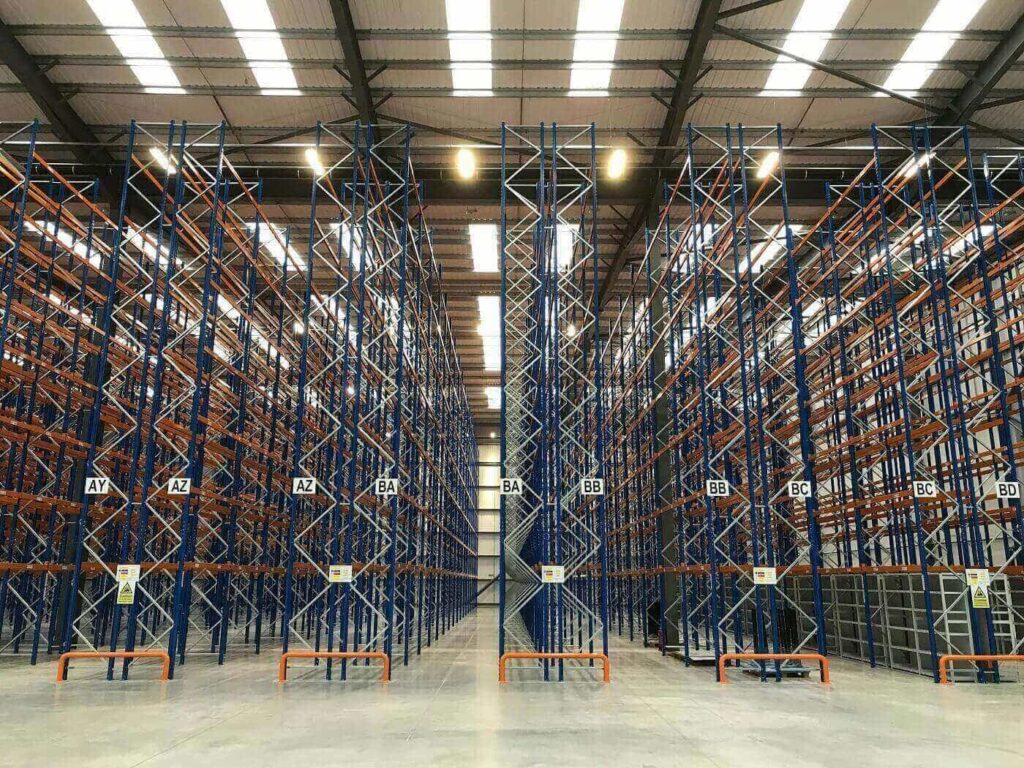
Start with Expert Warehouse Design Advice
Reducing aisle dimensions is an adjustment to your storage systems that will impact the wider operation. The process requires a strategic approach to ensure the changes align with:
- Forklift equipment and manoeuvrability
- Traffic flow
- Picking efficiency
- Dispatch performance
- Rack protection requirements
- Health and safety compliance
- Long-term scalability
A detailed review of your overall operation should be the first step. Stock profile, pallet dimensions, throughput levels, forklift types, future growth plans, and operational processes all need to be considered.
The physical characteristics of the warehouse itself will also need to be assessed to ensure:
- Structural columns do not obstruct proposed aisle locations
- Guided system suitability in relation to floor construction and expansion joints
- Sufficient space for additional racking runs within the overall building dimensions
At this early-stage expert guidance plays a crucial role, and WSL is well-placed to assist as an Approved Manufacturer Full SEMA member with decades of experience.
Our expertise proves invaluable when planning storage reconfigurations with aim of increasing storage capacity while driving warehouse efficiency. We’ve been working with businesses across multiple sectors since 1989, improving layouts and implementing practical storage solutions designed to support the long-term operational performance in individual warehouse environments.

Why You Might Consider Reducing Aisle Width
Aisles are an essential component in warehouse operations, providing the means to transport and access inventory. However, they do consume space, and the wider the aisles, the larger their spatial footprint, leaving less space for pallet storage.
When experiencing increasing stock levels, space constraints is likely to become one of your biggest operational challenges. A building expansion or relocation can interrupt operations and incur excessive costs, while improving the efficiency of your existing footprint is far more practical, affordable and avoids major disruptions.
Aisle width reductions will lead to a percentage of your floor space being reclaimed for storage purposes. Furthermore, sufficient height clearance presents an opportunity to add extra racking levels at the same time, improving utilisation of the full cubic area, resulting in:
- Increased storage capacity
- Delayed expansion or relocation
- More efficient use of existing space
- Readiness for future growth
- Improved overall efficiency
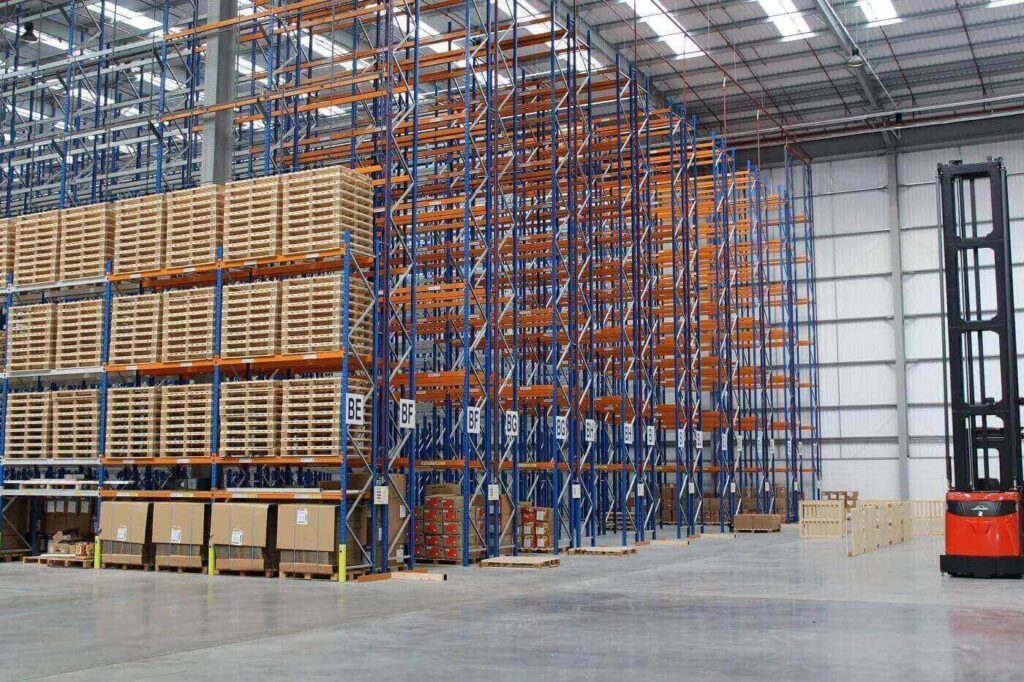
Why Aisle Width Matters
Access aisles are circulation areas, and while they do have a function, they are not used for storage. Aisle width matters to both storage capacity and operational performance. The right width will balance both, giving you sufficient access areas and storage volume that meets demand while maintaining:
- Forklift manoeuvrability
- Picking speed
- Safety compliance
- Traffic flow
- Warehouse productivity
- Future scalability
So, it’s a balancing act between maximising storage and maintaining efficient operations when deciding how wide your aisle should be.

How much extra capacity can narrower aisles create?
A reduction in aisles widths can have a positive impact on overall pallet capacity in your warehouse. In addition to more racking runs, racking height can be extended at the same time in taller spaces, further increasing pallet locations.
In some cases, the warehouse can achieve more capacity by changing the orientation of the racking itself. A 90-degree rotation could lead to a more efficient layout with additional bays or extra racking runs.
The increased capacity can be substantial, however the volume of increased capacity in your warehouse will depend on:
- The size of the warehouse
- Existing aisle width
- Current configuration
- Ceiling height
- Forklift equipment
- Operational requirements
In taller spaces, increasing the height of the racks can further improve storage density. However, the load-bearing capacity of the warehouse floor must be assessed to ensure it can safely accommodate the increased rack loads.
One certainly is that a reduction in aisle width, however moderate will increase storage capacity, helping to support growth while avoiding costly building extensions or relocation.
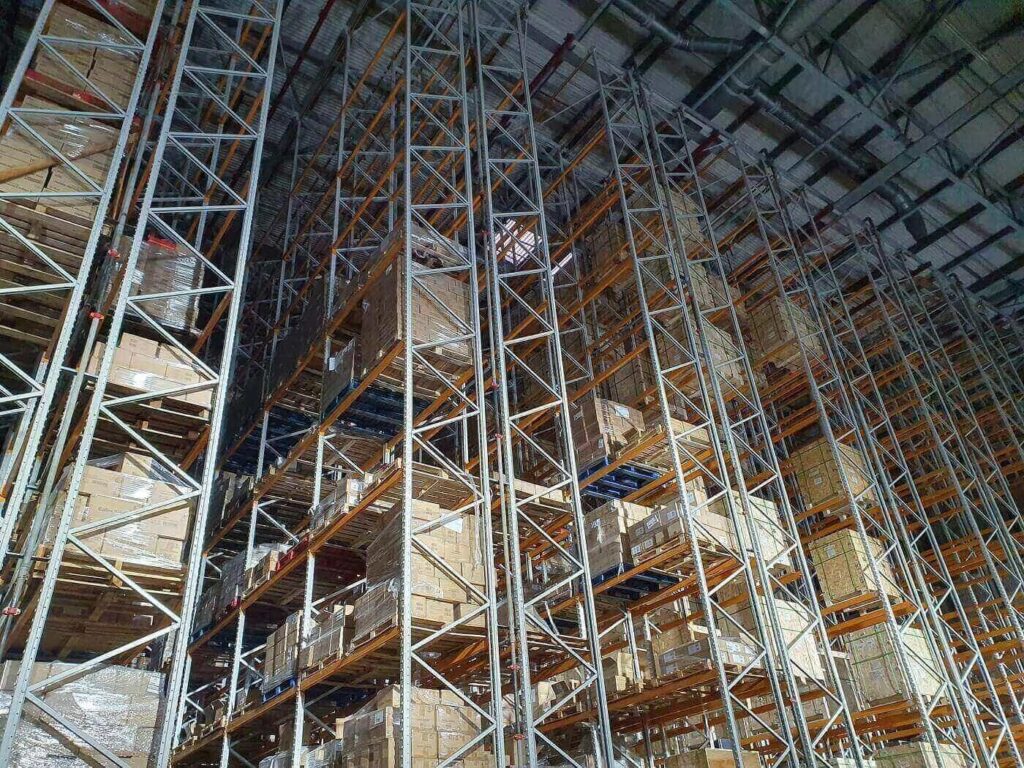
What is Considered a Narrow Warehouse Aisle?
Aisle width can vary in accordance with different warehouse environments, but typically, there are three main aisle width sizing categories, all configured using standard APR components which a valued for their flexibility. These include:
- Wide aisle layout
Wide aisle racking will generally feature aisle widths of 3.5-4 metres. A generous space that enables comfortable forklift manoeuvrability with suitability to standard counterbalance trucks.
Wide aisle layouts offer flexibility, ease of operation, and straightforward access to stock. However, the overall storage density of the warehouse is limited by the floorspace consumed by the aisles.

- Narrow Aisle Layout
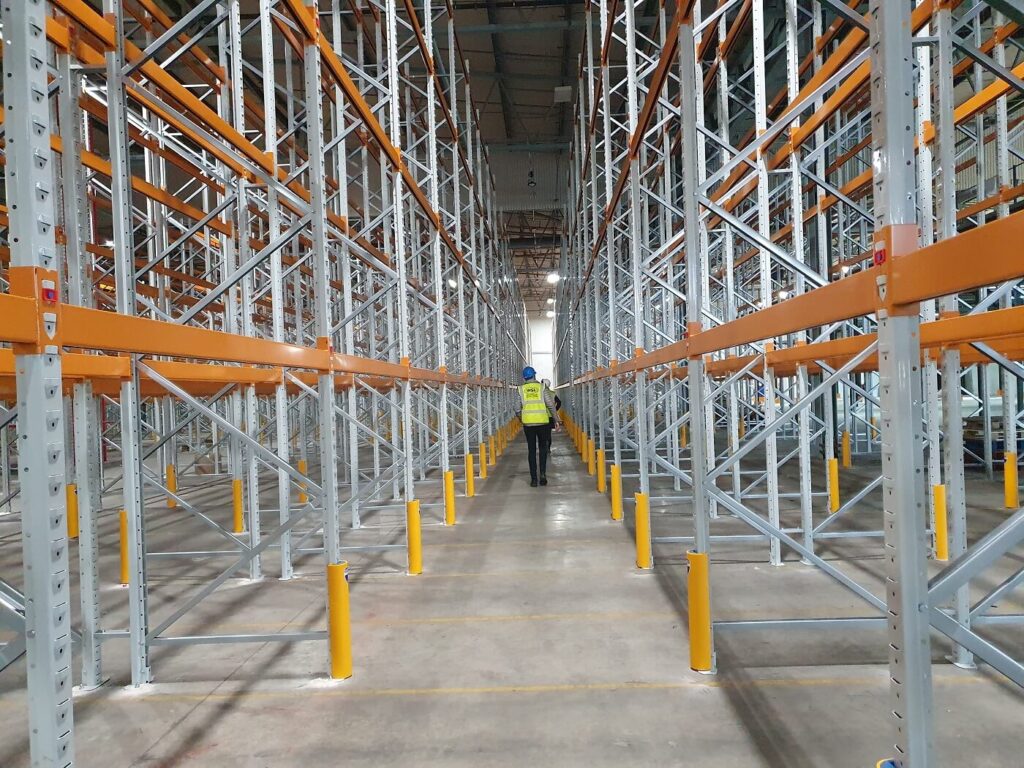
Narrow aisle racking operates with an aisle width of around 2.9 metres. The tighter space means that smaller trucks such as the three-wheeled counterbalance truck, reach trucks, or articulated forklifts.
Narrow aisles improve storage density through additional runs and extra levels if ceiling height permits, while maintaining direct access to every pallet
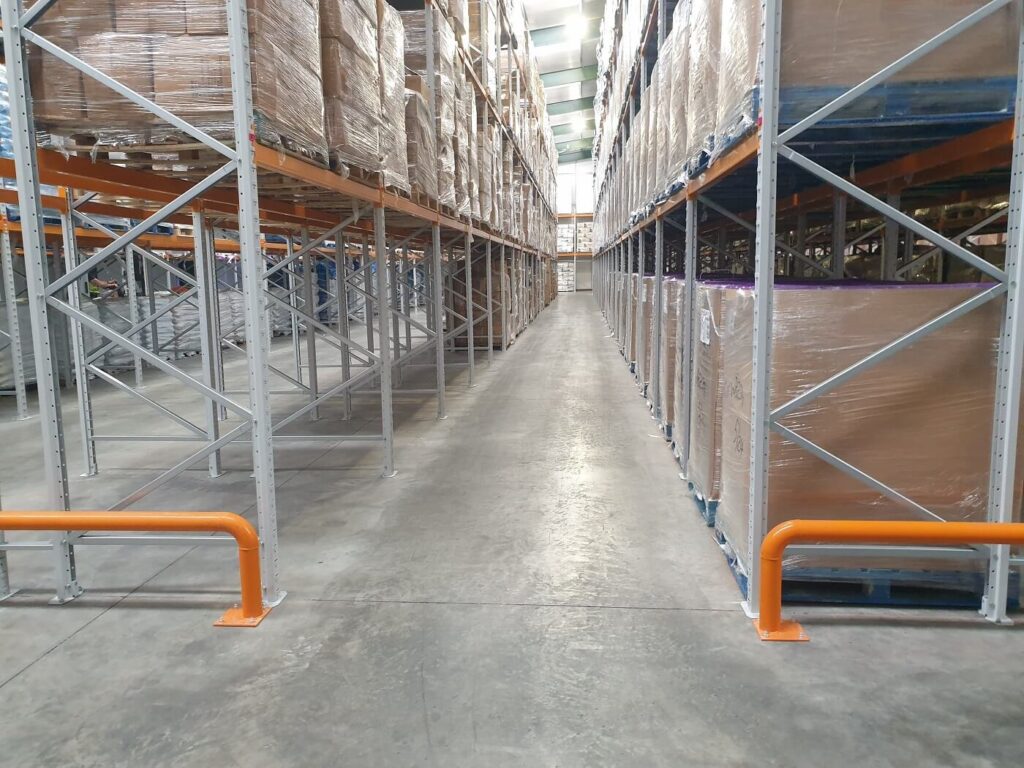
- Very Narrow Aisle (VNA) Layout
A very narrow aisle (VNA) racking system typically operates with aisle widths of 1.5-2 metres wide.
These layouts require specialist wire-guided or rail-guided VNA trucks designed for extremely narrow spaces, and a smooth, flat floor surface is essential to ensure the trucks and racks stay aligned.
Optimised for VNA aisle operations, the specialist trucks can be less effective outside the racks, however Pick & Deposit Stations (P&Ds) at the end of the aisles eliminates this issue and are used in many VNA warehouses. Standard trucks are kept in operation beyond the racks, while the VNA trucks remain where they are most efficient; between the racks. P&Ds allows for accessible pallet handling exchange for both truck types.
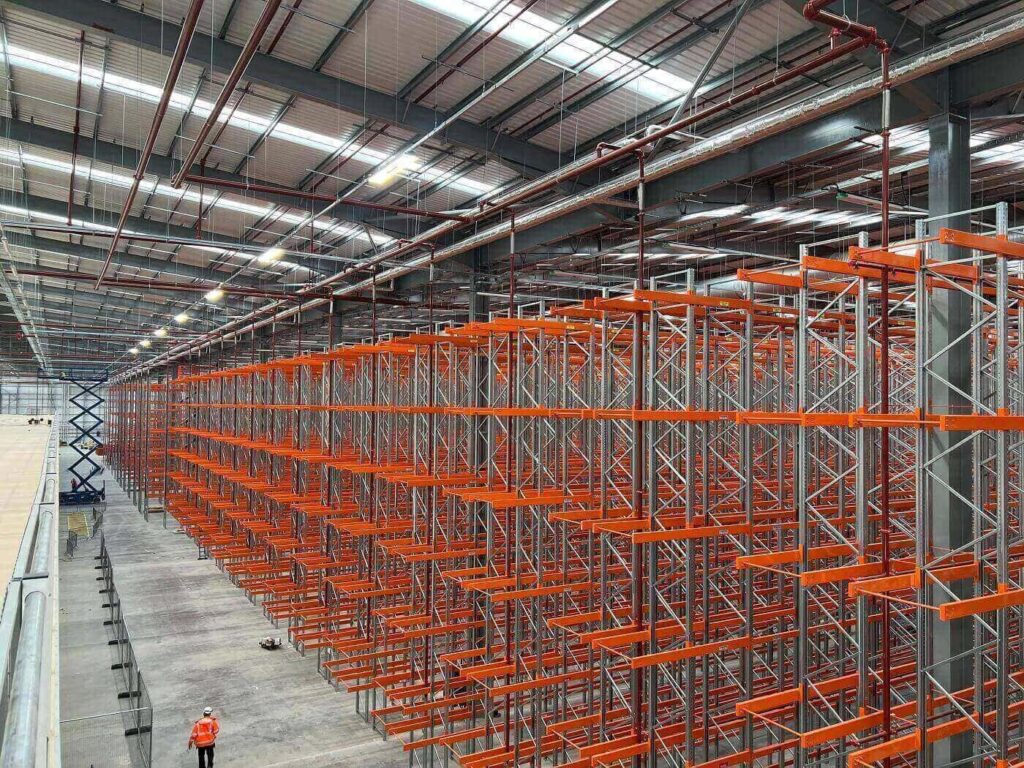
VNA systems offer maximum storage capacity and are particularly effective in tall spaces where the full height can be utilised alongside the floor area.

Narrow Aisle Racking Vs VNA Racking
Choosing the right racking layout will depend on multiple factors such as floor surface quality, handling equipment, operational needs, and overall warehouse space so it’s important to research the differences between narrow aisle and VNA racking systems in more detail.
Benefits of Reducing Warehouse Aisle Widths
- Increased storage density
The greatest and most obvious advantage is more storage space
Aisle width reduction creates more space for additional racking runs. The extra storage capacity can be significant, saving your growing business from the expense of a building extension or relocation.
- Better use of existing premises
Warehouse space is expensive lease, purchase, heat, light, and maintain. If there’s scope to improve the efficiency of your existing premises, it’s a far more cost-effective option.
By narrowing your aisle widths, you can maximise the value of your current premises.
- Delaying warehouse location
If you’re operation has outgrown its storage systems, it doesn’t always mean its outgrown the building itself. Aisle width reduction unlocks hidden space and can eliminate any immediate need for extra square footage.
- Improved vertical storage potential
Narrow aisle layouts are often paired with taller pallet racing systems. By utilising both floor and height space, the full cubic space becomes more functional and efficient while overall pallet density increases.
The challenges of narrower warehouse aisles
Narrow aisles offer clear advantages, but there are several important factors to consider:
- Specialist forklift equipment may be required
Standard counterbalance forklift trucks are often poorly suited to narrower aisles. Depending on the aisle widths, your operation may require:
- Reach trucks
- Smaller, flexible trucks
- Articulated forklifts
- VNA trucks
- Guided handling systems
While this can involve additional investment, the operational gains and increased storage capacity will often deliver a strong return.
- Picking efficiency may be affected
To increase storage capacity at the expense of operational efficiency is never an effective approach. Too much emphasis on storage capacity alone can result in aisles becoming too narrow for the demands of the operation, leading to congestion, slower picking times, and dispatch delays.
Careful warehouse planning is essential to ensure sufficient storage gains to match the needs of the operation without hindering throughput performance.
- Increased importance of rack protection
Tighter aisle clearance increases the risk of forklift impact and rack damage, making additional protection systems essential.
Guidance systems (such as a wire-guided truck) can help reduce the risk of damage. The truck movements are controlled by the guidance system rather that relying solely on operator steering.
- Floor quality may be critical
An uneven floor surface can be a safety issue in very narrow aisles environments. The unevenness beneath the truck can cause instability and misalignment at height. This is a safety risk and creates operational inefficiencies. Ensuring floor suitability is important before implementing a very narrow aisle system.
The proposal of wire-guided VNA systems will first require a detailed floor survey to assess the construction. Expansion joints and floor movement joints can interfere with wire guidance systems and hinder their performance.
Why Professional Warehouse Design Matters
Aisles width reduction should be considered as part of a wider solution, rather than just a “space saving adjustment”. All aspects of the operation need to be evaluated by a professional warehouse designer who will consider:
- Forklift requirements
- Load dimensions
- Traffic flow
- Fire safety regulations
- Rack loading requirements
- Future expansion
- Operational efficiency
- Warehouse safety
Other technical considerations include building column locations, floor condition, floor load capacity, and the potential for changes to rack orientation.
At WSL, we can develop a customised solutions that will improve capacity without compromising performance and safety. Every warehouse operation we work with is different, making our approach to tailored solutions essential for achieving the right balance between storage density, productivity, and safety within individual warehouse environments.

So, should you Reduce Warehouse Aisle Width?
Aisle width reduction in your warehouse will increase storage capacity and improve warehouse space utilisation. But a successful project will depend on careful planning, suitable equipment, and a professionally designed layout.
Warehouse efficiency is less about having the highest pallet count, and more about ensuring the right balance of storage density, safety, productivity, and efficiency in day-to-day operations.
If your considering changes to your warehouse layout, speak to WSL. We’ll fully assess how aisle width reduction will affect the wider operation and use the right approach to unlock substantial additional capacity while maintaining efficiency and safety standards for long-term performance.
Call us on 011 2045350 or email sales@wslmail.co.uk
FAQs
How narrow can warehouse aisles be?
It depends on your operational needs, floor surface condition, and forklift equipment. Wide aisles layouts are typically 3.5-4 metres wide, narrow aisles are around 2.9 metres, and VNA systems can go as little as 1.5 metres.
Do narrow aisles require specialist forklifts?
In most cases, yes. Reach trucks and articulated trucks are commonly used for narrow aisles systems. For the very narrow aisles of 1.5 metres, specialist VNA trucks are required.
Can reducing aisle width improve warehouse efficiency?
Yes, when carefully designed to ensure the balance of, improved space utilisation, traffic flow, efficiency, and safety.
Is VNA racking suitable for every warehouse?
No. VNA is a great option for operations requiring high density pallet storage, who have sufficient floor quality and ceiling height. Specialist equipment and guidance systems are also required.
Can narrowing aisles eliminate the need to relocate?
Yes, it can. The change from wide aisles to narrow aisles can provide substantial additional pallet capacity, allowing a business to continue growing, and operating within the same four walls.
What should be considered before reducing aisle widths?
Forklift types, traffic flow, stock profile, picking requirements, fire safety, rack protection, future growth, and sometimes floor conditions are all key elements to consider before reducing warehouse aisles widths. From the very early planning stages, it’s important to seek professional warehouse design advice.
Does a narrow aisle racking system require regular racking inspections?
Yes. All types of racking systems should undergo an annual racking inspection conducted by a professional inspector. Call WSL on 0113 2045350 to book your next inspection.
What components are used in narrow aisles racking?
Standard APR components are used to construct VNA racking, narrow aisle racking, and wide aisle racking, making it much easier and simpler to reconfigure or move from one layout to the other.
Will moving from wide aisle to narrow aisle hinder selectivity?
No. Every pallet is still accessible from the narrowed aisles.