
Warehouse Racking Systems
Double Deep Racking
Maximise Storage Capacity Without Sacrificing Flexibility
Double deep racking is a simple but effective adaption of standard adjustable pallet racking (APR), offering increase storage density while maintaining ease of use and cost efficiency.
WSL designs customised double deep racking solutions delivering similar simplicity, adaptability, and versatility as wide aisle racking, but with enhanced storage capacity
Key Benefits of Double Deep Racking
With a double deep racking configuration, you can:
- Store pallets two-deep to maximise floor space
- Increase storage density without investing in complex systems
- Install quickly using standard racking components
- Store a wide variety of products simultaneously
- Adjust beam levels to suit changing pallet heights
- Easily reconfigure to extend the system as your needs evolve


Double Deep Racking Explained
‘Double deep’ refers to a pallet racking configuration where pallets are stored two positions deep.
The structure is made up of standard APR components, consisting of frames, beams, and uprights, and requires no specialist components, unlike systems of intense density such as drive-in or shuttle racking. So, the difference with double deep racking lies purely in how the system is arranged.
Being stored two-deep and accessed on one face means the pallets are positioned front-to-back, with the rear pallet directly behind the front. To access both from the same face:
- The front pallet is accessed as normal
- The rear pallet is accessed using a fitted fork extension or telescopic forks
When implemented effectively, the double deep configuration offers more density than standard pallet racking, while retaining a level of selectivity not seen in ultra-high-density systems.
Where Double Deep Racking Makes Sense
For operations that need more storage capacity with reasonable access to stock, double deep racking is ideal.
Typical users include:
- Manufacturers storing similar inventory types, in medium volumes
- Third-party logistics (3PL) providers looking for density with accessibility
- Food and beverage distributors storing in batches
- Retail and wholesale operations handling repeat goods
- Warehouses looking to expand capacity and avoid relocating.
Double deep racking is practical and efficient in any operation where products are stored in pairs or batches.


Key Advantages of Double Deep Racking
Flexibility
The standard APR components used to construct the system are valued for their flexibility. Opting for the double deep configuration still allows for bays be adapted to different pallet sizes, new bays can be added or deducted, and without needing specialist components, the system can be converted to full selectivity (single pallet deep), quickly and easily.
Increased Storage Density
The standard APR set-up offers single pallet deep storage, whereas the double deep configuration increases density by halving the number of aisles needed to access the same quantity of stock. Meaning more space devoted to storing pallets, and less space used for access aisles.
Simplicity of Operation
You’ll need a fork extension for rear pallet access. Apart from that, double deep racking requires no specialist plant to operate, which keeps initial expenditure low. Operators can work efficiently with minimal additional training, and pallet access is much quicker than other deep storage systems, such as drive-in which involves forklift entry into the racking lane, or powered mobile where just a single aisle is opened for access, which can affect retrieval times
Strong Resale Value
The core components of a double deep racking system remain highly attractive on the second-hand market as it shares the same components as standard APR: the double deep components can be used to repair or extended other racking systems. This presents a significant advantage should you outgrow your current premises in the future and means that your repair costs for damages to your racks are much lower compared with repairing a specialist drive in system as spares are readily available. A second-hand stockist will often remove a double deep installation at no cost, or in some cases for a cash reimbursement. When vacating a rented property, this can go a long way towards meeting your lease-end obligations.
A Balance of Density and Selectivity
Double deep racking offers increased density over standard APR, and greater selectivity than ultra-high-density systems such as drive-in or radio shuttle.
In operations where SKU commonalty is too high to justify a fully selective APR system, but not sufficient to warrant a higher-density solution such as a drive-in with its minimum lane depth of four pallets and strict retrieval sequence, the double deep racking solution offers the perfect balance. It’s well suited to operations with:
- Moderate SKU variety
- Consistent stock turnover
- Products stored in similar batches
Is Double Deep Always The Best Option?
Double deep racking is an effective solution for many warehouse operations. Whether it’s suitable option for yours will depend on a range of operational factors, so it’s important to consider the following before implementation:
Floor Space Efficiency
Double deep provides more density than standard selective systems, but when measured against true high-density systems, its footprint efficiency is still relatively high.
An operation compromised by significant space issues while operating a standard selective system, may look to convert existing layouts into double deep. But this alone may not deliver notable gain where space is severely limited. A more effective solution might be to separate storage functions where selective racking remains purely for orders and fulfilment while a high-density system supports bulk storage.
Systems you could consider include drive-in/drive-through, pallet live, powered mobile, or radio shuttle.
A 'Middle Ground' System
Double deep offers dense storage, but not truly dense storage, and is selective, but not fully selective. It’s often described as the ‘middle ground’ delivering limited benefits of both but won’t achieve the full advantages and strength of both.
If you’re handling specific stock profiles and have a well-developed WMS in place, double deep is still a strong, affordable solution that enables increased density with sufficient selectivity, but it will require careful planning and disciplined stock management to be effective.
Double deep can sometimes be seen as the system that tries to be too much at once: a camel when what you really want is a horse. This can lead to compromise when your unsure of which features to prioritise when choosing a storage system, which is why a discussion with a WSL consultant can be genuinely helpful.
Aisle Space Vs Equipment Requirements
Because extended forks are needed to access the rear pallets, you’ll need either:
- Wider aisles to allow space for forklifts with extensions fitted to manoeuvre, or
- Investment in telescopic fork trucks which uses a powered hydraulic system to extend the forks when needed
This means a trade-off between space efficiency and higher capital costs. If you do choose telescopic fork truck, it’s worth noting it can operate in other applications, but its full capability is largely limited to double deep operations, making it a specialised investment.
If you’re looking to keep MHE costs down while maximising storage capacity, speak to a WSL consultant today.
Selectivity Limitations
Without a strong WMS in place, stock control can become complex when operating a double deep system. Manually matching product types to each bay can lead to stock misplacement or trapped pallets without a strong system, and operational efficiency can reduce over time.
If access to every pallet is priority, there are other options including standard APR or powered mobile racking. Our team can guide you through your options.


FAQs
What is double deep racking?
Double deep racking is standard APR configured specifically to store two pallets deep rather than one. It’s designed to increase storage density by reducing the number of aisles required to access the same number of pallets.
How does double deep racking work?
Each bay stores two pallets deep, where the rear pallet sits directly behind the front one. The front pallet is accessed normally, and the rear pallet is accessed using an extension fitted to the MHE forks, or by using telescopic forks.
What are the main advantages of double deep racking?
Double deep racking is simple, cost-effective and suited to a wide range of products, and is without complex or specialist components
Is double deep racking suitable for all warehouses?
Not always. For warehouses storing medium volumes of similar products or batch-based inventory, double deep can be a good solution but for operations with high SKU variety, or requiring immediate access to every pallet, a fully selective solution would be more suitable.
Do I need special equipment for double deep racking?
Yes, you will need either fork extensions or a forklift with telescopic forks to access the rear pallets. You may also need to allow for wider aisles depending on which MHE method you choose.
Does double deep racking support FIFO (First-In First-Out)?
No, double deep racking is a FILO (First-In Last-Out) system, but for the right kind of operation with a good Warehouse management System (WMS), you can work around this and avoid trapping pallets in the rear location.
How much space can I save with double deep racking?
Double deep racking can significantly improve storage density compared to standard pallet racking by reducing aisle space, but not at the same density as other systems like drive-in, powered mobile, or shuttle racking
Can double deep racking be reconfigured later?
Yes. Because it uses standard APR components, the system can be easily adjusted, extended, or even converted back into a fully selective layout if your storage needs change.
What are the limitations of double deep racking?
The main limitation is reduced selectivity. Rear pallets cannot be accessed until the front pallet is removed, which can lead to inefficiencies if stock is not well organised.
Is double deep racking a cost-effective solution?
Yes. It offers a strong balance between cost, storage density, and flexibility, making it a popular ‘middle ground’ option for many warehouse operations
Why choose wsl?
What Sets Us Apart
Our dedicated and experienced team will take time to understand your goals and asses your needs. Our extensive market knowledge and practical experience enables us to design and develop a bespoke system that is as unique as your business. Here at WSL we aim to maximise your available space and increase productivity through creating innovative and ‘outside the box’ solutions. Our commitment to excellence, our portfolio and our recommendations provide our customers with confidence in our ability to deliver solutions that are not only superior, but very cost-effective. Our in-house services simplify the process from design to installation by giving you just one port of call. By continuing to remain independent across the whole market we commit to providing our valued customers with the highest quality and – wherever possible – British products, all at competitive prices. We aim to fit our pallet rack systems with as little inconvenience to our clients as possible, using highly experienced fitters overseen by qualified project managers.
Our Accreditations


client stories
Some Case Studies
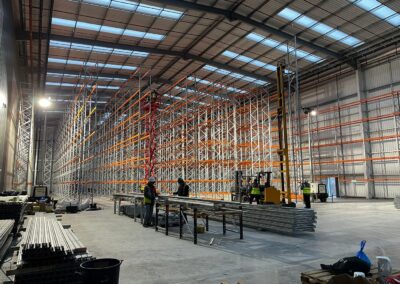
Our warehouse Racking experience is extensive. Take a look at a very small selection of some of the pallet racking projects we have completed over the years.


Trusted by all
Just Some Of Our Clients


Get started
Discuss Your Project
Our service is completely client-centric. We provide all manufacturer types, as well as fitters, engineers and inspectors; which means that not only can we deliver your entire project from start to finish, but that we can provide a fully bespoke solution for your individual needs. Get in touch to find out more.