
Warehouse Racking
Wide Aisle Racking
Specialist Wide Aisle Racking Solutions, Backed By SEMA Approved Expertise
Designed Around Your Operation. Installed With Confidence. Delivered Without Delay
At WSL, we’re trusted across the UK for designing and installing wide aisle racking systems, tailored to the needs of each individual project. As a SEMA Approved Manufacturer FULL Member, we ensure every installation meets the highest standards of quality and safety from start to finish.
We don’t just install racking, we take time to understand your inventory, equipment and space before designing the ideal solution. With a wide range of components held in our on-site warehouse, we are better able to reduce lead times and keep your project moving.
Plan with Confidence – Start with a Free Site Survey – We’ll visit your site, discuss your needs, and follow up with a bespoke quote. Call 0113 2045350 or email sales@wslmail.co.uk
What is Wide Ailse Racking?
Wide aisle racking is a configuration of adjustable pallet racking (APR) and is known for its high versatility and adpatability in storage applications. You can easily adapt it to suit your needs, even if you’re storing a broad array of items. It gives you direct access to individual pallets without the requirement for specialist handling equipment.
As well as versatility, the wide aisle racking configuration is extremely cost effective, making it a very popular option for those looking for a simple, affordable and effective solution.
A Popular, Highly Comprehensive Pallet Storage System with High Visibility and 100% Selectivity!
Key Benefits of Wide Aisle Racking
Versatility
Wide aisle racking can be adapted to support a full range of pallet sizes, weight loads and product types
Accessibility
Every pallet is directly accessible in a wide aisle pallet racking configuration
Cost Effectiveness
No additional components or specialist equipment required, making wide aisle racking relatively simple and affordable.
Simple Installation with Adjustability
A simple setup and highly adjustable to allow changing storage needs to be met through easy adjustment of beam levels
Safety
A larger aisle reduces the risk of forklifts colliding with the racks and assessing damage is quick and easy with a visual survey
Maximised Storage
Efficient use of vertical space without compromising accessibility
Operational Efficiency
This configuration of pallet racking allows you to use as many or as few pickers and forklifts to access stock as you wish with the wider aisles allowing room for passing vehicles
Forklift Compatibility
No need for a specialist forklift truck, it’s likely you can use the truck you already have


Wide Aisle Racking – Setup and Layout
Wide aisle racking is arranged in an accessible layout that balances storage capacity with operational efficiency, making it one of the most flexible warehouse storage solutions. The system is designed to allow storage of multiple pallet sizes and weights (within a maximum limit) and can give access by multiple forklifts to every pallet in the system, allowing a reliable and scalable operation.
Key characteristics of wide aisle racking include:
Spacious Aisles
With aisle widths of 3.5-4 meters, there is ample space for forklifts to navigate safely.
Pallet Accessibility
Unlike many other pallet racking types, the wide aisle system allows direct access to every pallet.
Adjustable Beam Levels
The flexibility to easily reposition beam levels allows for the accommodation of different inventory types at any time.
Structural Simplicity
Made from straightforward components and no moving parts, the system does not require additional or specialised components.
Wide Aisle Racking – Structural Components
This is an uncomplicated pallet racking system consisting of the following components:
Beams
Stock placed into a wide aisle pallet rackng system sits either on the ground level or higher up on beams. Two beams are required (front and back) to create a storage level. These beams connect into the uprights of the frames
Uprights
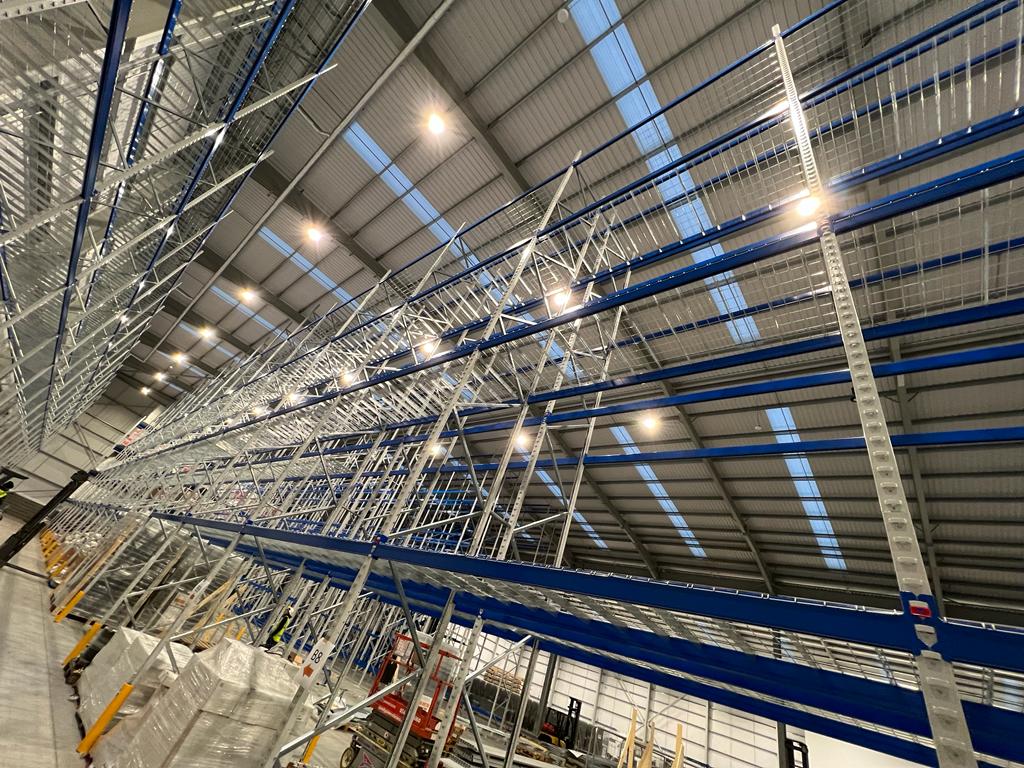
These are the vertical supports for the pallet racking, and connect to either end of the beam. Additional storage levels of beams can connect to the same upright, spaced apart, to make a pallet racking bay with multiple storage levels. The uprights are joined together to form a frame.
Frames
To stabilise the uprights while carrying pallets on the beams, two uprights (or more in some cases) are connected together with bracing (see photo on the right). The frame will have baseplates added on the bottom of the uprights to provide a steady base and to give a point to fix the frames into the warehouse floor to further stabilise the racking and prevent it shifting during operation. Frames distribute the weight of the pallets stored beams down into the warehouse floor, so the quality of the floor is important to allow wide aisle pallet racking to be erected.


Wide Aisle Racking – Safety and Protection Components
The wide aisles allow room for the fork lift trucks to manoeuvre between rows however, accidents can still happen and although the structure is very durable you can add protection from constant knocks and bumps by using upright, corner and end frame protection barriers.
Upright Protectors
These are barriers attached to the base of uprights to prevent damage from forklift impacts or from pallets when they are being deposited into the bay. Upright protectors are typically made of steel or high-density plastic, depending in whether they are being used to prevent an impact at high speed or simply to provide the operator with guidance.
End Frame Barriers
Heavy-duty barriers positioned at the ends of racking rows to prevent accidental damage from forklifts or other warehouse vehicles. They absorb impact and protect the racking structure from collisions. These are more robust than a upright protectors as they are situated in an area where forklifts may travel at a faster speed.
Corner Guards
Installed at the corners of racking systems, these reinforced steel or plastic guards provide additional protection to prevent damage from forklift collisions. They are particularly useful in high-traffic areas.
Weight Load Notices
Signage attached to racking systems that indicate the maximum weight capacity for each level. These notices are essential for safety compliance and help prevent overloading, which could lead to structural failure.
Wide Aisle Racking – Decking Options
Decking placed on pallet racking allows the user of the racks to store goods that do not span between the fron and back beams like boxes, totes or items that are not palletised.
Decking can also be used to support a structurally weak pallet (such as cardboard or shipping pallets) to prevent sagging, breakage and straining.
Decking can vary with some offering more durability than others, some being more resistant to fire and water whilst some are more prone to collecting dust than others. Your chosen decking type will depend entirely on your individual needs and budget.
The choice of decking options include:
Timber Decking
Timber decking can come in a number of forms, that all have their own advantages, but generally this comprises wooden slats fixed to each other to form a strong surface spanning the beams of the racking front-to-back. The slats can be placed with either a gap between them or hard-up (‘open / close boarded’) and the timber surface can be left with the sawn finish or refined for a smooth face (‘rough sawn / planed’).
Timber decking offers a durable, strong, and environmentally friendly solution. However, since timber is a flammable, natural product its use does have some limitations: particularly in food / hygenic applications, external uses, high-fire-risk areas or for use in sprinklered warehouses where alternative decking materials should be considered. The timber can be treated to reduce flammability and prevent mold however other options may present a better solution.
Chipboard Decking
Chipboard (also known as ‘particle board’) is made from wood offcuts (‘chips’) mixed with a binder/ glue and compressed to form a flat, uniform product. This can be used to create a solid surface on pallet racking beams making a picking shelf level for the storage of lightweight and smaller items that could fall through the gaps in open board timber decks.
Chipboard tends to be a more economical alternative to planed-close-boarded timber decks through it does have a few disadvantages: chipboard is weaker than timber and depending the on the grade of material and treatment used it is still flammable and porous which precludes its use in the same environments in which timber decking should not be used.
Steel Pan Decking
A steel pan is a type of heavy-duty decking made from a solid section of flat steel and bent at the front and back ends to hook over the front and back beams of a pallet racking level. Steel pans offer superior strength and fire resistance compared to timber and chipboard decks.
Steel pans are strong enough to support a weaker pallet to be stored on the pallet racking (as well as stillages, undersize goods and heavy non-palletised items) whilst also presenting a solid shelf level that is easy to clean and, when suitably coated, weather resistant.
The drawback of steel pan decking is that it can be overkill for many operations and alternative decking options are often more econonical whilst fulfiling the needs of the operation.
Pallet Support Bars
Pallet support bars (PSBs) are steel supports that span the racking beams front-to-back and sit under the stringers of the pallets being stored to provide support to weaker or lower quality pallets (such as shipping or cardboard pallets), stillages, and even non palletised goods.
PSBs hold a number of advantages over timber, chipboard and pan decks in that they are fire/ water/ mold resistant, easy to clean, quick to fit and are much more cost efficient than all other decking types for their application.
The principal drawbacks of PSBs are that they cannot be used as a solid shelving level and that the operator can only use pallet supports when they know the exact items being stored and the PSBs are installed accordingly: any differences in the size and shape of the pallet to be stored may lead to the pallet missing the location of the supports.
Pressed Decks
Pressed decks are formed from a panel of pre-galvanised steel. This steel panel is bent and rolled into a rigid deck and shaped at the edges to make a lip to hook onto the front and back beams of a pallet racking storage level. Shelf levels of pressed decks are made from a number of individual panels sat next to eachother to provide high capacity, durable, cleanable, and solid shelf level allowing the user to store a wide range of goods: from heavy boxes to smaller products that would fall through the gaps of other decking options.
While pressed decks are a stronger and more hygenic decking alterative to chipboard, and often more competative for high load applications, they do not have as high a loading capacity as steel pans, PSBs, mesh or timber decks when used to support a pallet and should be used primarily for shelving.
Pressed decks come in a viariety of widths, material gauges and styles tailored to the end users requirements and can be a versatile solution.
Mesh Decking
Mesh decks are constructed from steel mesh panels welded to channel supports that sit on the racks and span the racking beams front-to-back. Mesh decks levels can be made from a single deck (for smaller bays) or may comprise multiple decks.
Mesh decks are a very good all-round solution to creating a flexible storage level on pallet racking: they can be used to convert a beam level into a shelving level whilst also being very strong (working equally well for pallet support or for small parts storage). The gaps in the mesh allow for sprinkler systems to penetrate the racks in the event a fire, making mesh decks the preferred solution in sprinklered warehouses.
Mesh deck levels, as the name would indicate, are not a solid shelf, meaning that they also allow warehouse lights to reach through the bay (so long as they are not full with goods). For some applications the increased air-flow offered by mesh decking versus ither small-parts-storage decking solutions ( such as chipboard or pressed decks) can be an important consideration.
The drawbacks of mesh decking are that it is not as strong as pans or PSBs, as rigid as timber decks, or a solid shelving solution like chipboard/ pressed decks meaning that it may not be suitable for a user’s super-high-capacity applications or for the storage of very small individual items (which may fall through the mesh grid).
Mesh is a highly durable, versatile, and cost effective decking solution; equally capable supporting pallets as it is for creating a picking level – whilst also being more cost efficient than some of the other decking options.


Why Many Choose Wide Aisle Racking
There are a number of reasons why wide aisle racking is a good choice for many warehouses. Budgetary and time constraints can be easily met through this one simple solution.
Common and Simple Design
- Basic yet robust structure with minimal components.
- Affordable, easy to use, and quick to assemble.
Highly Versatile and Adaptable
- Suitable for various industries requiring flexible storage.
- Can store a wide range of items simultaneously.
- Beams can be easily repositioned to accommodate inventory changes.
- Ideal for businesses with variable inventory or seasonal demand.
-
Easy Access and Efficient Operation
- Direct access to individual pallets without specialist handling equipment – it’s very likely that you could use you existing FLT)
- Every pallet is visible and can be picked directly from the working aisle.
- Enhances efficiency in picking operations.
-
Wide Aisle Racking in Industries
Wide Aisle Racking is extremely versatile making it a popular choice for many industries. The uniform components, flexible configuration, clear visibility, immediate access and easy control of inventory are desirable attributes for business of all types, as is the quicker delivery and assembly versus other storage solutions.
This makes it difficult to pin-point a single business type or industry that will likely use wide aisle racking, however at WSL we have designed and installed wide aisle pallet racking solutions for operations in industries as diverse as:
- The food and drink industry
- Retail
- Manufacturing
- Wholesale
- Ecommerce
- 3PL/ Transport
Adjustable pallet racking (whether in a wide aisle layout or any other configuration) is also at home in all environments: ambient warehouses, cold stores and freezers.


Maximising Storage with Wide Aisle Racking: Three Unique Solutions
At WSL, we understand that every warehouse has its own set of challenges, from structural obstacles to the need for flexibility and temperature control. Wide aisle racking has proven to be a versatile and efficient solution for businesses across different industries. Here are three case study highlights showcasing how we helped our clients optimise their storage.
Overcoming Structural Challenges in a Kitchenware Warehouse
A growing kitchenware supplier needed extra storage space and found a warehouse with the perfect size and location. However, a crane runway running through the building, along with floor-to-ceiling columns, posed a major obstacle. WSL designed a wide aisle racking system that worked around these obstructions, allowing for full optimisation of the space without interfering with rack height. The result was a flexible storage solution capable of supporting a varied and ever-changing inventory. [Read the full case study here.]
Future-Proofing a Surplus Supermarkets’ Storage Needs
Company Shop, a surplus product supermarket, explored multiple racking options for its new dry food storage facility. Wide aisle racking emerged as the best choice due to its straightforward design and ability to adapt to changing demands. With rapid growth in mind, the system was designed to incorporate 2,000 pallet locations, ensuring all inventory remained easily visible and accessible via standard forklifts. This long-term solution provided the adaptability needed for future expansion. [Read the full case study here.]
Efficient Chilled Storage for Craft Beer Production
Leeds-based craft brewer Northern Monk Ltd required a cost-effective racking solution for its new chilled storage facility. The system needed to accommodate around 250 pallets of beer barrels while withstanding consistently low temperatures. WSL’s wide aisle racking system met all these requirements and was installed quickly, despite construction delays from other contractors. Thanks to our efficient installation team, the warehouse was fully operational by Christmas. [Read the full case study here.]
Design Options
Wide aisle racking can be designed and configured to suit your space and inventory. This includes the height of the racking, number of beam levels, aisle width and loading capacity.
Wide aisle racking can also be designed to incorporate other solutions such as carton live shelving for example. This creates multiple solutions within one system, supporting both palletised and non-palletised inventory at the same time
Additional Beam Levels
Wide aisle racking can have multiple beam levels in the same racking bay. How many can be fitted depends on the vertical space in your warehouse and the height of the goods that you are looking to store.
Maximising storage by extending the racking vertically and adding more storage levels is a practical approach for warehouses with high ceilings to significantly increase storage capacity without expanding the warehouse footprint, making it a cost-efficient solution for high-volume storage environments.
Varying Beam Loads
A good way to maximise cost efficiency when purchasing pallet racking is to define the product being stored into different weight limits and assign differnt weights of product to certain beam levels. Having every level capable of storing 1t pallets when half your stock is only 500kgs per pallet will waste steel and increase the price of the racking system. There is no issue with beam levels in pallet racking having different loading capacities so those 500kgs pallets can be placed on a beam level suitable for their weight and your heavier stock can be located on a heavier duty beam. Just make sure that your load notice clearly states which beam level is suitable for which pallet weight.
Picking and Pedestrian Access
The height to the underside of the first racking beam level is important if you want to pick from the pallets stored on the ground level below the rack. Leaving at least 2m clear to the underside of the beam from the floor will allow staff to walk in and out of the bay, break down the pallet into individual boxes/ items and pick smaller products directly from the pallet (reducing the double-handling that occurs when stock is moved from racking into shelving for picking access).
The space below the first beam level can be used as a fire escape route but you will need to make sure that there is enough head room and that there is a clear path through the bays marked as an escape route. This can be done with barriers or through putting down line marking, clearly showing that a pallet should not be deposited on the escape route.
Storing Non-Palletised Loads
Pallet racking can also be used to store non-palletised items on the beam levels such as stillages, boxes for picking, reels of material (such as carpets), and even whiskey barrels!
You may need to apply decking to those levels to make a solid surface or help these non-standard loads span the front and back racking beams (see the decking section above).
Incorporate Carton Live Shelving
You also have the option of integrating carton live shelving levels into wide aisle racking to enhance picking efficiency. Carton live provides easy access to fast-moving goods.
These gravity-fed roller tracks allow items to move forward automatically, ensuring First-In First-Out (FIFO) stock rotation where stock is picked in one aisle and then replenished from the next. Carton flow gives access to a higher range of products than a pick-from-pallet system while storing more product than a convetional shelf level.
Warehouse flow can be improved by separating picking and replenishment operations by aisle with bulk storage in upper bays and picking activities below. This design benefits fast moving, high quantity, order picking, such as e-commerce.
Implementing this system can significantly boost productivity while maintaining an organised and ergonomic workspace for warehouse operators


Wide Aisle Racking and Your Business Space
Wide aisle racking is suited to a wide range of industries and product types; will it suit yours? Here are a few reasons why it could be….
Inventory
- Supports all types of palletised goods, including non-standard pallets.
- Smaller loads like barrels and crates can be stored using decking.
- Stores multiple product types at once.
Decking
- Choose from chipboard, timber, wire mesh, or steel decking to match your needs.
Operational Needs
- Ideal for operations that require breaking down pallets for individual picking.
- Easily adapts to different sizes and volumes while maximising storage capacity.
Design Options
- Can combine pallet storage above with decked shelving levels below for hand-loaded goods.
- Can support varying pallet weights on each beam level
- Fitting high-density, fast-paced Carton live shelving at the lower beam levels can enhance your picking operation.
- Wide aisle racking can be built as high as you warehouse will allow with as many beam levels as you require.
See our pallet racking guide to help you compare other pallet racking types agianst wide aisle pallet racking.
Considering Wide Aisle Racking? Lets talk!
Unsure if wide aisle racking is the right fit for your business? WSL offers a free, no-obligation site survey to help you decide. Our expert designer will visit your site, assess your space, and create detailed plans with a tailored quotation. You’ll have the opportunity to discuss your requirements in depth, ask any questions, and explore the best storage solutions for your needs. Call WSL today on 0113 2045350 or email us at sales@wslmail.co.uk

The benefits
Why Choose Wide Aisle Racking?
When you have the right wide aisle racking system for your storage facility, it will allow your warehouse space to be optimised and efficiently managed.
Efficiency & Accessibility
Wide Aisle Racking removes the need for specialist equipment to access the racks as the wide aisle provides access for all types of fork-lift trucks.
Popular
Due to its versatility & efficiency, it is the most commonly used racking system within warehouses throughout the UK.
Store Different Items All in One Place
If you have a range of products, wide aisle racking enables you to store them easily and efficiently, all in one warehouse.
Simple & Flexible
It is the simplest of racking storage solutions to install and provides a very versatile option for storage requirements.
Why choose wsl?
What Sets Us Apart
Our dedicated and experienced team will take time to understand your goals and asses your needs. Our extensive market knowledge and practical experience enables us to design and develop a bespoke system that is as unique as your business. Here at WSL we aim to maximise your available space and increase productivity through creating innovative and ‘outside the box’ solutions. Our commitment to excellence, our portfolio and our recommendations provide our customers with confidence in our ability to deliver solutions that are not only superior, but very cost-effective. Our in-house services simplify the process from design to installation by giving you just one port of call. By continuing to remain independent across the whole market we commit to providing our valued customers with the highest quality and – wherever possible – British products, all at competitive prices. We aim to fit our pallet rack systems with as little inconvenience to our clients as possible, using highly experienced fitters overseen by qualified project managers.
Our Accreditations


client stories
Some Case Studies
Our warehouse Racking experience is extensive. Take a look at a very small selection of some of the pallet racking projects we have completed over the years.


Trusted by all
Just Some Of Our Clients


Get started
Discuss Your Project
Our service is completely client-centric. We provide all manufacturer types, as well as fitters, engineers and inspectors; which means that not only can we deliver your entire project from start to finish, but that we can provide a fully bespoke solution for your individual needs. Get in touch to find out more.