
What is Adjustable pallet racking (APR)?
Adjustable pallet racking (APR) is one of the most widely used pallet racking solutions in the warehouse and logistics industry, and for good reason. With just a few core components, APR delivers exceptional flexibility, scalability, and adaptability. Whether you’re operating a high-volume distribution centre or a smaller warehouse with mixed inventory, APR offers a tailored, futureproof solution that can adapt as your business grows.
APR systems can be configured in various ways to suit specific operational needs, helping businesses to optimise both their floorspace and workflow. Based on its fundamental components and broad range of racking configurations, what’s possible with APR?
The Building Blocks: APR Core Components
At its core, APR is made up of three essential components:
- Frames – Each frame consists of two parallel uprights standing vertically and held together by diagonal bracings. A baseplate is fixed to the base of each upright and bolted to the floor to ensure stability and effective weight distribution.
- Beams – Positioned horizontally between the frames, beams are installed in both the front and rear uprights at each level. This creates multiple bays designed to hold pallets.
- Beam Locks – These secure the beams by fixing them to the uprights to prevent lifting or movement during use.

Optional Components to Enhance APR Functionality
Decking Options
Decking is used to form a solid surface and close the open space between the front and rear beam, ideal for storing smaller items or non-standard pallet sizes.
- Timber decking – Wooden slats, usually treated for durability. Effective but flammable and harder to clean
- Chipboard decking – Affordable and smooth but not suited to damp or hygiene-sensitive environments.
- Steel pan decks – Heavy-duty and fire resistant. Suitable for food and pharmaceutical storage. More costly but very durable.
- Pallet support bars (PSBs) – Provide pallet support without forming a full shelf. Strong, economical, and resistant to mould, fire, and water.
- Pressed decks – Lighter and customisable. Ideal for smaller, individual items. Fire resistant and easy to clean.
- Mesh decking – Constructed from steel wire, allowing light, water, and air through. Good for fire safety and hygiene but not ideal for very small items.

Safety Mesh Options
Fitted to the rear of the racking bays to prevent items from falling into walkways or work areas:
- Anti Collapse Mesh – Rigid steel mesh that prevents dislodged items from falling through the back.

- Mesh Netting – A more flexible alternative made from durable fabric, though more expensive as each net is custom made. Netting is a low maintenance solution as the net will flex upon contact with pallets or boxes pushed through rather than deform like anti-collapse mesh.

Protecting the Structure: Racking Safety Components
Even with the durability of steel, racking remains vulnerable to accidental impacts in busy warehouse environments. The right safety accessories help preserve the system and maintain structural integrity.
Foam Lined Upright Protectors – Plastic tubes with foam lining that wrap around the racking uprights. They don’t stop direct FLT impacts but provide a tactile warning if a pallet or truck is misaligned, helping drivers correct their position before causing damage.

Upright Guards – Floor-fixed folded steel guards set slightly away from the racking uprights. They absorb low-level collisions, protecting the uprights when FLTs access rack locations, like foam protectors.
Corner Guards – Folded 2-sided steel guards installed at aisle ends to shield corner uprights from vehicle collision when drivers turn into the racking aisles.
End of rack barriers – These can be fully steel (like tubular barriers, Armco etc) or they can be a composite plastic/ steel guard designed to absorb impacts and rebound. These shield the exposed ends of racking runs from traffic collisions in cross-aisles and prevent damage from depositing stock against the end frames of the aisles.

Weight load notices – Clearly displayed signage that informs operators of the maximum load per pallet and other key safety guidance.
APR Configurations: What can you achieve?
Thanks to its modular design, APR supports a variety of racking configurations. Each offers unique benefits depending on your warehouse layout, product types, and handling processes.
-
Wide Aisle Racking
The most traditional APR configuration, offering:
- Direct access to every pallet
- Compatibility with standard forklift trucks
- Simple installation and reconfiguration
Best for: General warehousing, fast moving consumer goods (FMCG), and operations with high SKU turnover. It’s also ideal for warehousing operations with a high variety of stock in low quantities.
Design note: Requires aisles around 3.5-4 metres wide, reducing the number of racking runs but allowing ample space for FLT manoeuvring. Compared to higher density systems, more space is used for aisles and less for storage.

-
Narrow Aisle Racking
Ailse widths are reduced to around 2.7-3.5 metres, increasing storage capacity without sacrificing accessibility.
- Higher storage density than wide aisle
- Retains direct pallet access
- Suitable for busy environments with multiple drivers
Best for: E-commerce, wholesale, and logistics hubs looking to maximise storage within the same footprint as a wide aisle configuration.
Design note: Requires specialist reach trucks or forklifts for the reduced aisle space. For taller systems, it should be noted that the higher you go; the flatter your floor needs to be to prevent tipping.

-
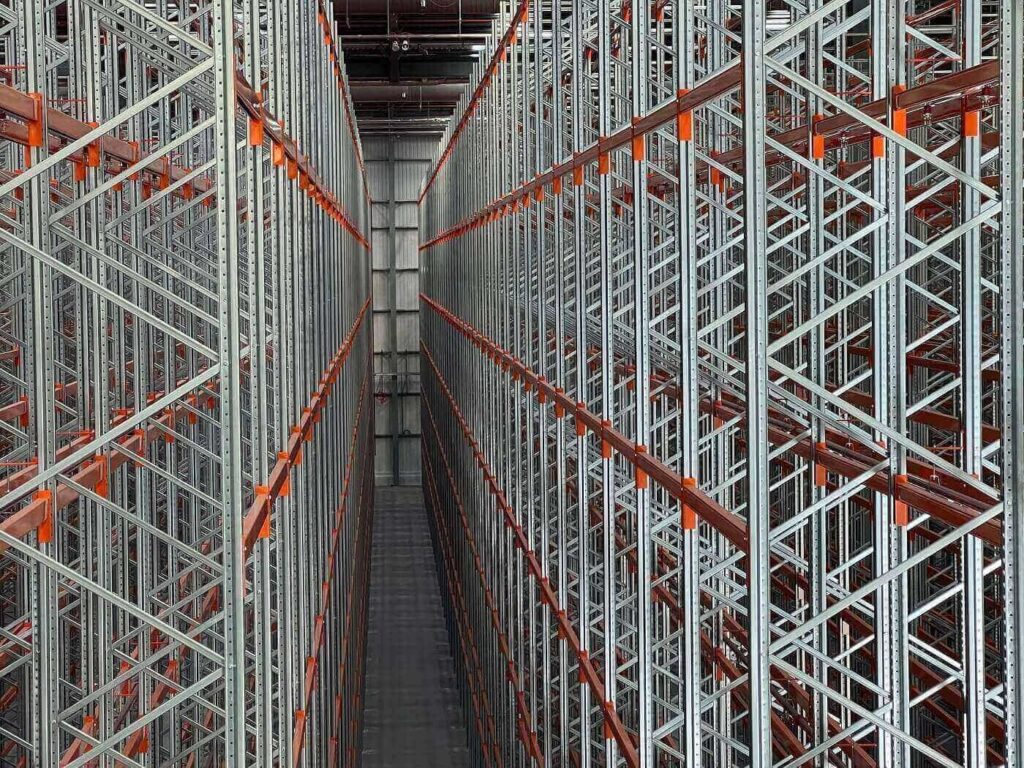
Very Narrow Aisle (VNA) Racking
Aisles reduced to just 1.6-2 metres and racking heights significantly increased for ultra-high-density storage.
- Maximum use of vertical space
- Maintains individual access to each pallet
Best for: High-SKU environments that must have access to any individual pallets like pharmaceuticals, automotive parts, and 3PL providers
Design note: Uses large, specialist, VNA trucks (wire- or rail-guided) that operate only in forwards/backwards within aisles and reach heights up to 17 metres. Standard trucks are still needed for transportation outside the racking and can be used at pick and deposit (P&D) stations for pallet transfer.
-
Double Deep Racking
Pallets are stored two deep per bay, with one behind the other, reducing aisle count to increase storage density.
- Greater volume per square metre
- Ideal for bulk storage
Best for: Seasonal stock, bulk inventory, and non-urgent picking.
Design notes: Requires fork extensions or extending forks on the forklift trucks and reduced accessibility to the rear pallet demands strategic stock rotation for perishables.

-
Mobile Racking
APR mounted onto movable bases to eliminate fixed aisles. A single aisle is opened only when access is needed.
- Highest possible storage density whilst maintaining 100% selectivity
- Maintains full selectivity
- Excellent for temperature-controlled environments.
Best for: Cold storage, high-value goods, archive storage or slow-moving goods with high variety SKUs.
Design note: Motorised for movement of the racks, which requires maintenance. Slower operation speed, so more suited to less frequently accessed items
Beyond Pallets: Non-Standard Uses for APR
APR isn’t just for pallets. By swapping out horizontal beams for custom supports, PR can be adapted to suit a range of unconventional storage needs:
Vertical racks – Designed for storing long, lightweight items like pipes using vertical brackets instead of horizontal beams. Items lean inward for support and stability. These can be standalone units or integrated into an APR system with dedicated vertical storage.

Reeled Storage – Reels are mounted on horizontal bars within the bays, allowing them to rotate freely without touching surrounding surfaces. This setup ensures smooth dispending and prevents damage during handling.

Carton live shelving – Features roller shelves positioned at picking height, enabling First-in First-out (FIFO) stock rotation. Ideal for environments where stock turnover is critical, particularly in high-volume small parts handling.

Why APR Delivers Long-Term Value
At WSL, we know that warehouse operations are constantly evolving. Whether your product lines grow, or your stock mix changes, or you relocate, APR allows you to adapt without a complete overhaul.
Thanks to its modularity, APR can be extended, reconfigured, or relocated using existing components. We regularly revisit customer installations years down the line to help them scale up cost-effectively, often integrating their current racking into new layouts.
If you’re looking for a racking system that delivers flexibility today and adaptability for tomorrow, APR is a smart investment that pays off time and again.
Looking to optimise your warehouse space with APR?
Get in touch with the team at WSL. We’ll help design a tailored solution that delivers the capacity, safety, and efficiency of your operational needs.
Call us on 0113 2045350 or email sales@wslmail.co.uk
FAQs about Adjustable Pallet Racking (APR)
What is adjustable pallet racking (APR)
Adjustable pallet racking (APR) is a modular storage system that uses upright frames and horizontal beams to store palletised goods. It offers flexibility, scalability, and reconfigurability, making it suitable for a wide range of warehouse types.
What are the benefits of APR?
APR allows for tailored storage layouts, easy access to individual pallets, and efficient use of both floor and vertical space. It can be expanded or reconfigured as your operation grows or changes.
Which APR configuration is best for my warehouse?
The best APR configuration depends on your stock profile, picking strategy, and available space. Wide aisle racking is ideal for general warehousing, while VNA and mobile racking are better for high-density or temperature-controlled environments. WSL can help you choose the right layout based on your needs.
Can APR be used for non-palletised items?
Yes. APR can adapt for vertical pipe storage, reels of material, or even carton-live shelving for small parts picking. Its flexibility makes it ideal for mixed inventory.
Is APR suitable for food, pharmaceutical, or cold storage?
Yes. With the right decking and coatings, APR can be safely used in hygiene-sensitive or temperature-controlled environments. Mobile APR is especially effective in cold stores.
How safe is adjustable pallet racking?
APR systems are highly durable, but safety accessories like upright protectors, barriers and weight load notices are essential for protecting your staff and equipment. Regular inspections and proper installation are key to ongoing safety.
What’s the typical cost of an APR system
Costs vary based on the configuration, size, decking type, and accessories. As a rough guide, a basic APR setup is a cost-effective option compared to more complex systems, such as the shuttle racking, pallet live and push back racking. Contact WSL for a tailored quote based on your space and operational needs.
How long does an APR installation take?
Installation times depend on the complexity and size of the system. A small, standard APR layout can be installed in a matter of days whilst a more advanced system with additional infrastructure such as having sprinklers, decking and guards may make the process a little longer. WSL will always work to minimise disruption to your operation.
Can APR be moved or re-used if I relocate?
Definitely. One of the biggest advantages of APR is its reusability. Systems can often be dismantled, moved, and reinstalled, sometimes with no need to purchase additional components.
How do I get started with an APR system?
Simply contact the WSL team. We’ll assess your space, stock, and workflow to design a solution that fits. Call 0113 2045350 or email sales@wslmail.co.uk to get started.