
Floor markings are one of the most effective tools for enhancing warehouse safety, particularly around pallet racking systems. In busy warehouse environments, where large storage structures are common, these markings help establish clear visual guidance and support the segregation of pedestrian and vehicle traffic. This separation is essential for maintaining safe and efficient navigation throughout the facility.
For many of our clients, especially those operating large-scale facilities, floor markings are a critical element in managing both vehicle and pedestrian traffic. When markings are aligned with racking layouts and dimensions, they help streamline traffic flow and significantly improve overall safety.
Effective warehouse floor marking requires careful planning. This includes selecting the right marking type, adhering to relevant regulations, and designing layouts that enhance both safety and operational efficiency.

Why floor makings matter in warehouses
Warehouse design goes beyond just racking itself, its also about creating a safe, organised, and efficient working environment, with floor makings playing a key supporting role.
Warehouse floor markings serve several functions:
- Safety guidance: Clearly marked floor lines can define pedestrian walkways, vehicle lanes and restricted zones to help prevent accidents by safely separating different traffic types.
- Organisation: Makings support effective inventory management and help enforce storage policies
- Efficiency: Workflow can be significantly enhanced through floor makings which help to streamline navigation and reduce confusion.
Areas around pallet racking presents some of the highest risks for collision and injury due to the frequent use of forklift trucks and other material handling equipment. That’s why, as pallet racking specialists, we emphasise the importance of integrating effective floor markings into racking layout designs.

UK Regulations and Guidance
There are several standards and regulations UK warehouses must comply with and some dictate how floor markings are implemented:
Health and Safety at Work Act 1974
The core of the Health and Safety at Work Act 1974 focuses on employer’s duty to protect the health and safety of employees in the workplace. This includes implementing suitable control measures, such as floor markings, to help ensure a safe working environment.
Management of Health and Safety at Work Regulations 1999
The Management of Health and Safety at Work Regulations 1999 require employers to conduct risk assessments and implement appropriate health and safety measures to maximise employee protection. As part of effective workplace safety management, warehouse floor markings help reduce the risk of collisions between pedestrians and vehicles and should be used wherever feasible.
Workplace (Health, Safety and Welfare) Regulations 1992
Regulations which set out requirements employers must meet in relation to health, safety and welfare in the workplace. With a focus on workplace traffic routes, section 17 mandates vehicle movement to be segregated from pedestrian movement. Warehouse floor markings provide clear indication of safe and segregated routes for vehicles and pedestrians.
HSE Guidance – HSG76: Warehousing and Storage: A guide to Health and Safety
Essential reading for warehouse safety, the HSG76 recommends the use of floor markings to indicate:
- Pedestrian walkways
- Vehicle routes
- No-go zones
- Racking protection areas
- Loading/unloading zones
Types of Floor Markings Around Pallet Racking
There are several different types of floor markings used in warehouse environments, each serving specific functions around racking.
- Walkways and Pedestrian Zones
Pedestrian zones are clearly marked, sometimes using solid lines, or symbols such as a walking person and wording can also be used. The markings define these areas as safe for pedestrian only traffic, which is essential for shared space between pedestrians and forklift trucks. In some warehouses, a physical railing is used to reinforce the segregation of pedestrian access.

- Vehicle Route and Forklift Lanes
Often highlighted using dashed lines, arrows and directional cues to help guide traffic flow and reduce the risk of collision near the racking aisles.
- No-go-zones
Used to indicate dangerous areas such as the end of racking runs or corners with poor visibility, these zones are often painted in a crosshatch pattern to signal “do not enter”.
- Racking Protection Areas
These markings are sometimes implemented along the border of the racks to alert forklift operators of distance to the structures. These are often reinforced with upright protectors and barriers.

- Parking Areas
Located away from the racks and typically nearer the loading docks these markings provide a specific area to park handling equipment such as forklift trucks or low-level order pickers (LLOPs)

- Marshalling Areas
Another dedicated area, away from the racking aisles marked out for pallet placement to allow the management of split orders, labelling and shipping preparations.

Floor Marking Colour Coding
Warehouse floor markings play a crucial role in maintaining safety and efficiency by clearly highlighting key areas, pathways, and hazards. While floor markings are deigned to be highly visible, selecting the appropriate colours is essential for ensuring quick and easy recognition.
There are no legal requirements dictating which colours must be used for specific zones or activities. However, consistency is vital. Once a colour is assigned to a particular purpose, such as green for pedestrian walkways, it should be used exclusively for that purpose throughout the entire facility. This avoids confusion and helps employees and visitors safely navigate the space, whether on foot of operating vehicles.
A consistent and well-communicated colour-coding system not only improves safety but also supports productivity by reducing hesitation and misinterpretation in busy warehouse environments.
See the chart below which outlines common warehouse colour-codes which could help to guide colour choices for your facility:

Materials and Methods for Floor Marking
The effectiveness of floor markings depends not just on design, but the materials and application methods used. Choosing the right solution depends on the environment, durability requirements, and visibility needs.
Tape Markings
Tape is a flexible and convenient option, ideal for temporary or semi-permanent floor making needs. Available in a variety of colours and finishes, including anti-slip and reflective options, its quick and easy to install with no curing time.
Highlights:
- Quick and easy to apply
- Available in many colours and finishes
- Anti-slip and reflective variants available
- Suitable for temporary layouts or frequent changes
Challenges:
- Can peel or lift over time, especially in high traffic areas
- Less durable than paint-based solutions
- May require frequent replacement in demanding environments
Paint Markings
Painted floor markings are more suitable for long-term or heavy-duty environments. Thy provide excellent adhesion and high visibility, and options are available to match different environments and conditions.
Epoxy 2 pack paint
- Durable for at least 2-3 years in high-wear areas
- Requires 24 hours curing at a minimum of 10oC
Water-Based Acrylic Paint with UV Curing
- Lifespan of over 5 years
- Area can be returned to use immediately after installation
Highlights:
- Long-lasting and highly durable
- High visibility and colour customisation
- Suitable for heavy-duty and industrial environments
- Can incorporate anti-slip and anti-scuff
Challenges:
- Longer application and curing time (for non-UV options)
- Surface preparation is critical for best results
- Less flexible than tape or temporary or changeable areas
- More expensive than tape solutions
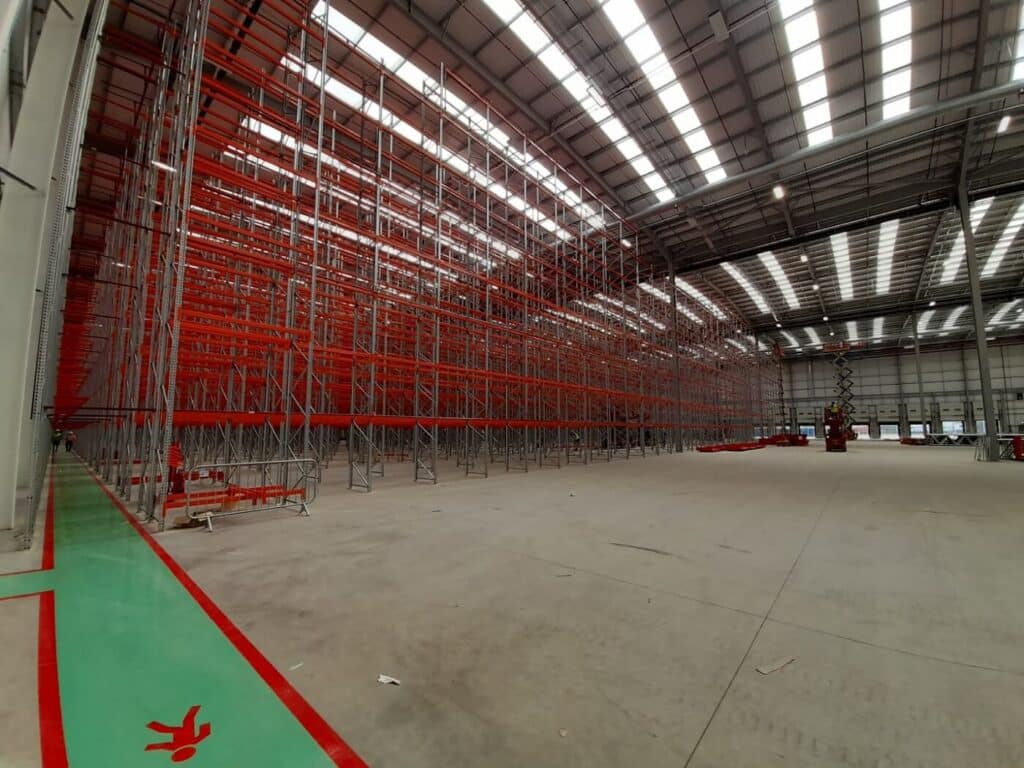
Case Study example – Durable Floor Lines using Water-Based Acrylic Paint with UV Curing
Following a recent racking reconfiguration carried out by our team, the customer required hard-wearing, long-lasting floor markings to support high traffic levels in their busy distribution warehouse. Clear, durable lines were essential to ensure safe navigation around racking structure reaching hights of up to 14 metres with 30 aisles and numerous forklift trucks in operation.
To meet these demands, the customer selected a water-based acrylic paint with UN curing. This solution offered immediate usability after application, providing piece of mind and eliminating the need for frequent maintenance or costly remarking.
As shown in the image below, the customer opted for green walkways with yellow borders and diagonal crosslines to enhance pedestrian visibility and support safe movement throughout the facility. These markings were applied exclusively to designated pedestrian access aisles, helping to minimise foot traffic in operational areas. This clearly indicates where pedestrians are permitted to walk while alerting vehicle operators to zones where pedestrian presence is likely. Additionally, a red stop line was installed at the end of each aisle to ensure forklift operators come to a halt and give way to traffic in the cross aisles.

Best Practices for Floor Marking Design Around Pallet Racking
Follow a colour code: Using consistent colours throughout the warehouse makes it easier for staff to recognise markings quickly.
Ensure high visibility: Reflective photoluminescent materials may be beneficial in low-light areas. Good lighting further enhances the visibility of floor markings.
Include signage and symbols: Supplementing floor markings with signs, arrows, and symbols helps reinforce messages, especially in multilingual environments.
Maintain and inspect regularly: Floor markings can wear over time, especially near pallet racking where frequent traffic occurs. Regular inspections help to ensure lines remain visible and effective.
Design with racking layout in mind: Floor markings should complement, not conflict with, the layout of your racking.

Common Mistakes to Avoid
Even with good intensions, poorly executed floor marking can lead to confusion or safety issues. It’s important to avoid these common pitfalls:
- Inconsistent colours or symbols
- Cluttered markings or overlapping zones
- Faded or warn lines not maintained
- Lack of staff training on what markings mean
- Changing layouts without updating markings
The link between floor markings and racking protection
Floor markings do more than direct traffic. They help to protect your investment in pallet racking. A small collision involving a forklift and an upright can compromise the structural integrity of a racking system. Marking out buffer zones or no-drive areas significantly reduces these risks.
Well-marked protection zones can work in tandem with physical racking safety ancillaries such as corner guards, barriers or upright protectors to create a more resilient warehouse environment.
The difference floor makings can make
Consider a warehouse distributing fast-moving consumer goods (FMCG) and the operator is experiencing regular near misses between forklift drivers and pedestrians near the end of pallet racking aisles.
A few ways in which floor makings could help improve safety concerns include:
- Introduce high-contrast yellow floor markings around the base of each racking upright
- Create clearly defined pedestrian walkways, offset from the racking aisles
- Add STOP-LOOK-LISTEN symbols at junctions for pedestrians
- Place a red stop line marking to encourage operators to stop to giveaway to traffic along the cross aisles.
- Incorporate red crosshatched floor markings to highlight “no pedestrian” zones in front of the racking.
This would help to reduce near misses with pedestrians whose confidence when moving around the warehouse would improve. It would also limit the risk of collisions with the racking structure, preventing damage and saving on repair costs.

Training and engagement
Floor markings are only as effective as the workforce that uses them. Include floor markings awareness as part of induction training and refreshers. Visual communication tools such as posters or digital screens can also reinforce key messages.
Involving warehouse staff in the planning or review process can improve and uncover practical insights on traffic flows or hazards.
Future Trends: Smart Floor Markings
Technology is beginning to play a larger role in warehouse safety. Smart floor markings including LED-illuminated lines and projected floor signs are emerging in high-tech facilities. These offer flexibility and visibility in dynamic environments and may become more widespread in the UK as the cost of implementation falls.
Integrating Floor Marking in Smarter Warehouse Design
At WSL, we know that floor markings are a crucial, but often underestimated element of effective warehouse design, especially around pallet racking. When thoughtfully planned and properly implemented, they can do more than meet safety regulations, they can enhance efficiency, reduce risk, and help protect your team and infrastructure.
By combining the right materials with strategic layout planning, floor markings can become a seamless part of your operational success. If you’re reviewing your warehouse layout or planning new installations, talk to WSL about solutions that can elevate safety and performance across your facility through effective racking design and crucial floor markings advice.
Contact our team today by calling 0113 2045350 or email sales@wslmail.co.uk
Floor Markings – Frequently Asked Questions
-
Are floor markings a legal requirement in UK warehouses?
Under UK Regulations such as Workplace (Health, Safety and Welfare) Regulations 1992 require employers have a duty to segregate pedestrian and vehicle traffic. Floor markings are a practical way to achieve this and support compliance.
-
What colour should I use for pedestrian walkways and vehicle routes?
Specific colours aren’t legally mandate; however, consistency is crucial. If green is used for pedestrian walkways, it’s important to ensure green has the same purpose throughout the warehouse to avoid confusion.
-
How durable are floor markings?
This would depend on the floor marking material used. Whilst tape is quicker to install, it would likely wear more easily in high traffic areas when compared to paint. Paint markings (especially EV cured paints) are more durable and best suited to busy environments.
-
Can floor markings be used around existing racking systems?
Yes. Floor markings can be placed around an existing racking system. To avoid disruption to your operation, the work should be planned carefully.
-
How often should floor markings be inspected or replaced?
You should include floor marking inspections to your regular safety checks. Any markings that have faded, peeled, or become unclear should be replaced.
-
Do I need a specialist contractor to apply warehouse floor markings?
In-house installations are not advisable, particularly for long-term, large-scale applications, especially paint-based systems. Professional contractors can ensure accuracy, durability and compliance.
-
How do floor markings work with racking protection systems?
Yes, when used alongside physical safety features such as upright protectors or barriers, floor markings can significantly reduce the risk of damage or injury. Floor marking contributes to racking safety by acting as a physical buffer and traffic guidance, steering traffic away from the racking structure.
-
Can floor markings improve productivity as well as safety?
Absolutely. Clear, well-organised routes help to streamline navigation, reduces hesitation and improves traffic flow. This promotes improved efficiency and a safer working environm