
Warehouses have changed dramatically over the last few decades. What were once predictable, bulk storage facilities, often in remote locations with periodic picking and despatch, have become high-activity operational hubs at the centre of business strategy.
Back in 1989, e-commerce was still in early development, with limited infrastructure and little public access to the internet. That same year marked the founding of WSL, as a designer and installer of innovative industrial storage solutions. Since then, we’ve worked within an ever-evolving industry, witnessing first-hand the profound impact fast-growing ecommerce has had on supply chains.
Today’s warehouses:
- Serve many channels (B2B, B2C, e-commerce, wholesale)
- Handle constant stock movement
- Support same-day or next-day delivery
- Often manage light assembly, custom packaging and labelling
- Process high volumes of returns
- Adapts to frequent SKU changes
Keeping up with relentless demand requires optimised structures and a layout that prioritises efficiency, safety and space maximisation. WSL can guide you through this, and help you meet these challenges head-on through a strategic warehouse design built around your inventory, operational processes, and long-term goals.

Modularity and Scalability: The Foundations of Modern Storage
To keep pace with change, your warehouse needs infrastructure that can expand, adjust, and reconfigure, without the need for a complete replacement every time your business evolves.
Flexibility in your storage systems can allow you to:
- Increase capacity within your existing footprint
- Adapt to new or seasonal product lines
- Reconfigure layouts to improve workflow
- Respond quickly to peak demand
- Scale storage in line with business growth
- Maintain required inventory management, flow and speed
If your storage can move with your operation, your operation will move faster, smarter, and becomes more profitable.
Storage Solutions That Deliver Real Flexibility
Flexibility isn’t optional. It’s essential. To achieve it, you’ll need adaptability, density, scalability, or a combination. The most effective solution is always one designed around your specific operation, while incorporating core elements designed support future changes. Some of these include:
Adjustable Pallet Racking (APR)
Adjustable pallet racking widely used of many operations, and industries, and for good reason too.
It’s a system constructed from uprights, beams, and frames. And is robust, cost effective, and highly adaptable. APR is suited to operations with varied pallet heights and frequently changing SKU profiles.
How it supports adaptability:
- Adjustable beam levels for varying pallet heights
- Bays and levels easily added or removed
- Supports evolving product mixes
- Compatible with standard forklift trucks in wide aisle racking configurations
- Can be installed back-to-back for double-deep storage
- Maximises vertical space with narrow aisle or VNA racking configurations
APR will adapt easily to changes in your inventory, without any major disruption or capital expense.

Case Studies:
APR wide aisle configuration maximised space for a growing kitchenware specialist while overcoming obstructive structural components in the building.
VNA racking solution created 30,000 new pallet locations created for toy retailer
A simple solution created using basic components meant a lightning-fast pallet racking installation for event logistics client
Mobile Racking
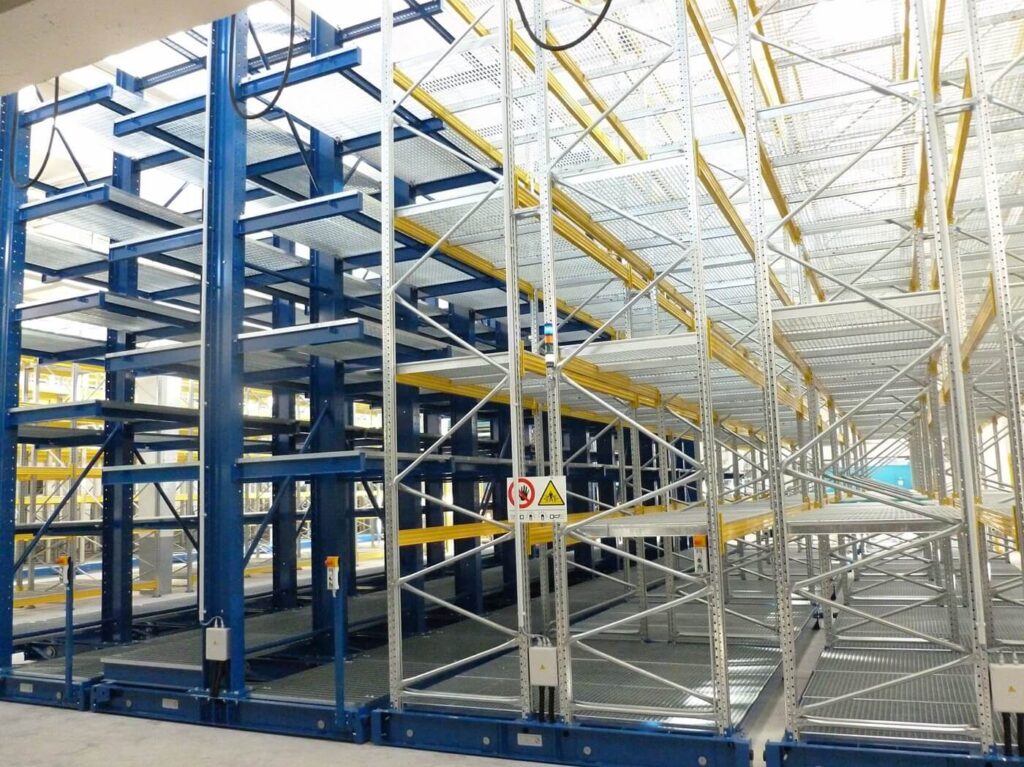
Mobile racking is basically standard APR, but mounted onto a power mobile base. Instead of fixed working aisles, the racking runs are compacted together, and to place or retrieve a pallet, a temporary aisle can be opened as and when required.
Compared to traditional wide aisle racking, mobile systems can increase storage capacity by up to 300%.
How it maximises space:
- Dramatically Increases capacity without expanding your footprint
- Ideal for high SKUs and temperature-controlled goods
- Reduces the need for relocation or costly extensions
- Supports varied product types with a compact layout
If floor space is tight, and your managing a wide range of products, mobile racking could unlock hidden capacity within your existing building.
Drive-in/Drive-through Racking
Designed for high-density storage of uniform products, drive-in/drive-through racking systems eliminate horizontal beams to create deep storage lanes. Each level features rails running the length of the lane to support pallets with forklift trucks entering the lanes to load and retrieve stock.
How it optimises bulk storage:
- Maximises cube utilisation for high-volume SKUs
- Support peak-season sulk storage
- Configurable for FILO (First-In Last-Out) or FIFO (First-In First-Out)
- Ideal for fast-moving or consistent product lines
It provides a strong solution if your balancing bulk storage with rapid dispatch.

Case Studies:
WSL provides 1000 new pallet locations for fruit supplier with bespoke drive-in racking design
WSL maximises warehouse efficiency by creating drive-in racking solution for solar panel storage.
Push-Back Racking
Push-back racking offers high-density storage while maintaining selectivity on a lane-by-lane basis. As a pallet is loaded, it pushes existing pallets further into the lane. When the front pallet is removed, the remaining pallets move forward automatically.
How it improves efficiency:
- Increases density without sacrificing accessibility
- Improved picking speed
- Ideal for medium-turnover SKUs
- Allows quick lane reallocation as demand shifts
Push-back racking provides high capacity storage in a limited footprint area and is ideal if speed is a priority.

Pallet Live Racking
Pallet live racking uses gravity-fed roller lanes. Pallets are loaded at one end and flow forward automatically to the picking face as stock is removed.
This system is particularly effective for high-throughput environments where stock rotation is critical.
How it enhances flow:
- Supports strict FIFO stock rotation
- Reduces forklift travel time
- Increases picking efficiency
- Handles high volumes with smooth product flow
- Ideal for chilled, perishable, or time-sensitive goods
If your operation is under pressure to move stock quickly and accurately, pallet live racking delivers on both speed and control.

Shuttle racking system
Shuttle racking is a semi-automated, high-density solution where pallets are transported within lanes by remote-controlled shuttles.
Once a pallet is placed at the entrance, the shuttle carries it to the correct position, reducing forklift truck movement and increasing throughput.
How it drives performance:
- Handles high volumes efficiently
- Reduces forklift traffic and associated labour costs
- Can support both FIFO and FILO configurations
- Can extend to 20 plus pallets deep
- Increase operational speed with multiple shuttles and forklifts
For businesses experiencing rapid growth, shuttle racking combines density, efficiency and speed.

Cantilever racking
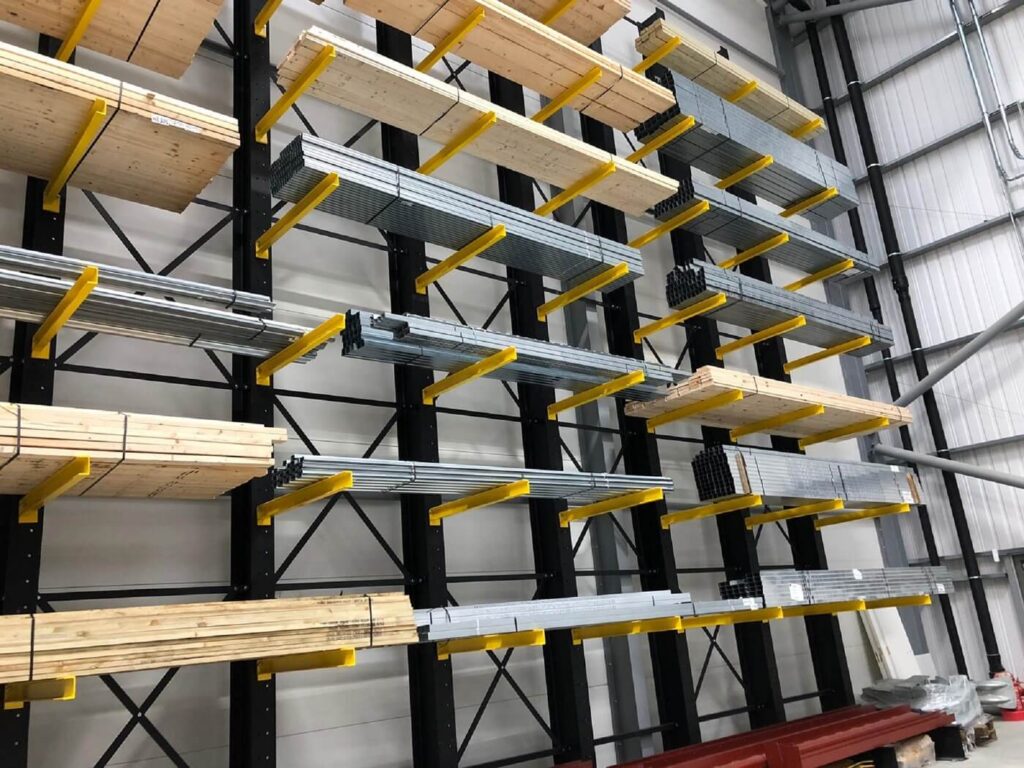
Cantilever racking is a great solution for non—palletised goods. This could be long, bulky or awkward loads such as timber, piping, steel bars or white goods.
Unlike traditional pallet racking, it features horizontal arms extending from vertical columns, allowing for unobstructed loading and unloading.
How it supports non-standard products:
- Accommodates none-palletised, irregular products
- Arms can be adjusted as product dimensions change
- Option of single or double-sided configurations
- Suitable for both indoor and outdoor use
If your storing oversized or unconventional materials, cantilever racking can prevent wasted space and removes awkward storage and handling issues.
Mezzanine Floor Solutions
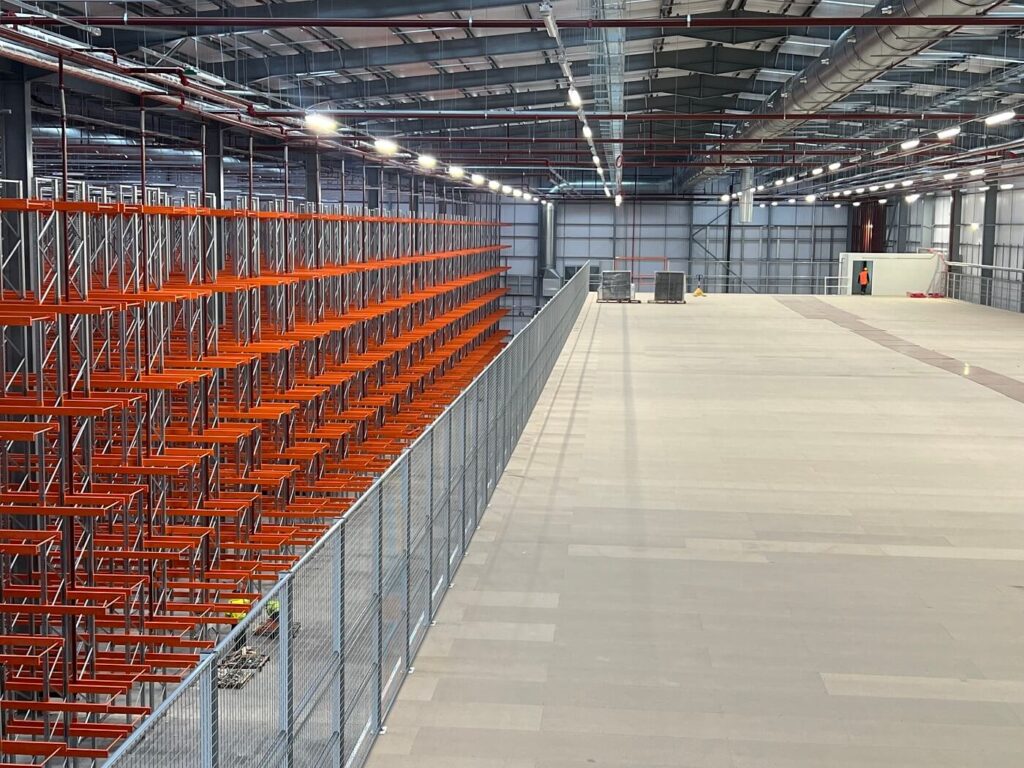
When ground floor reaches capacity, mezzanine floors allow you to build upwards, creating additional operational areas without relocating or extending your building.
How it expands capacity:
- Increases usable space with your existing structure
- Suitable for storage, picking areas, light assembly, offices, or staff facilities
- Can incorporate multiple levels
- Easily extended or reconfigured as demand grows
- Separates processes to streamline workflows
With no impact on the original building structure, a mezzanine platform can provide breathing room when growth outpaces floor space.
Case Study:
Multi-tier mezzanine with VNA racking transforms new DC space acquired by Fat Face Ltd
Mezzanine installation elevates efficiency for plumbers’ merchant
Driving Flexibility Through Intelligent Design
True flexibility starts at the design stage.
At WSL, we take a strategic approach and take time to understand your operation before we begin any work in designing your solution, because no two warehouse, or growth journeys are the same.
The future might be unpredictable, but with the right storage solutions in place, your warehouse is always ready for change.
The flexibility you require depends on:
- Your inventory profile
- Throughput rates
- Available space
- Handling equipment
- Long-term growth plans

Designed Around Your Operation
Our Technical Designers begin with a detailed site survey and in-depth SKU analysis, mapping operational flow before recommending any solution.
We take the time to understand:
- Available space – so we maximise every square metre
- Pallet and product dimensions – to ensure optimal fit
- Load weights – to maintain safety compliance
- Picking methods – to improve speed and accuracy
- Handling equipment – to guarantee compatibility
- Growth projections – so your warehouse works just as hard in the future, as it does today.
Our in-house capabilities as both a designer and manufacturer give us the flexibility to meet your operational requirements without constraints of third-party suppliers. With our factory and engineers all operating under the same roof, our teams benefit from a direct corridor of communication, bringing all expertise together in one place.
All our fabricated products are UKCA certified, and this sits alongside our Approved Manufacturer Full SEMA membership, ensuring the highest standards of safety and quality.
We design a solution engineered for today, and the future. Discuss your project with our team today. Call 0113 2045350 or email sales@wslmail.co.uk
FAQs
Q. How do I choose the right racking system for my warehouse?
A. You’ll need to consider your SKU profile, throughput, available space, pallet dimensions and growth plans. This will help to identify whether you need selectivity, density, or a hybrid solution. WSL Design Technicians can help you navigate the options and design a solution for now and for what will come next.
Q. Can I increase storage capacity and avoid moving a larger building?
A. Yes. WSL have helped many businesses do this, by unlocking substantial hidden space through reconfiguration alone. There are many ways to increase capacity within the existing space, such as deep-lane storage, taller racking structures and mezzanine floor installations. It’s much more affordable and far less disruptive when compared to moving.
Q. What is the difference between FIFO and FILO, and why does it matter?
A. FIFO is ideal for perishable or time-limited goods as it works on the basis that older stock is picked first, while FILO suits bulk uniform products without critical rotation requirements. With an understanding of your inventory needs, WSL’s design team can help you choose the most efficient system for your operation.
Q. How disruptive is a new racking installation?
A. When carefully planned, any disruption is minimal. Installations by WSL within a live operation would consist of phased stages and sometimes outside peak hours to maintain workflow continuity.
Q. How important is warehouse design in overall performance?
A. Critical. The purpose of WSL’s warehouse design process is to improve workflow, reduce handling time, and support long-term scalability. This requires storage infrastructure which has been thoughtfully planned to streamline picking, improve stock accuracy, and promote safety.
Q. How quickly can a new system deliver ROI?
A. Return on investment is driven by improved space utilisation, increased picking efficiency, reduced travel time, and avoided relocation costs. The advantage to growing operations, is that scalable systems prevent repeated capital expenditure as demand increases.