
Efficient warehouse operations hinge on smart storage solutions and pallet racking is the backbone of any operation handling palletised goods. The pallets themselves are significant to the design of your pallet racking system, which is designed to support a variety of pallets and other products. Pallet material, size, and weight capacity all affect system compatibility, load distribution, and overall efficiency. For seamless integration with the racking system, the type of pallets in use is a key factor in the overall design and performance of your pallet racking setup.
Understanding the basics: What is a pallet?
A pallet is a low-profile, portable platform used to support goods in a stable manner while being lifted or moved by material handling equipment such as forklifts. Pallets are a critical component of supply chain logistics, serving as the interface between goods and the storage infrastructure. Once loaded with goods, pallets are transported into storage where they remain until retrieval is required.
While their primary function remains consistent, pallets vary in material, size, and design. For a pallet to be placed and stored safely on a pallet racking structure, it must fit physically, and the racks must be designed to accept the pallet weight and size safely.

Material differences: Wood, Plastic and Metal Pallets
Wood Pallets
The most broadly used, wooden pallets are cost-effective, durable and easy to repair. Their flexibility in size and customisation make them a popular choice, particularly for general warehousing although it should be noted that wooden pallets can vary in quality and are susceptible to overuse and moisture damage.
Impact on racking design
- Inconsistent dimensions or warping – most pallets are consistent and made to a set design (See CHEP and EPAL product range), however many shipping pallets are custom made for a particular product, of lower quality materials (such as plywood or chipboard), with single use in mind.
- Variable weight capacity across different wood types and conditions should be considered in the final design, ensuring the capacity to uphold the heaviest load scenario.
- Moisture retention can lead to corrosion of both pallets and racking, but applying a galvanised finish, especially in damp or outdoor environments, offers a protective barrier against this risk
Wooden pallets and racking types
Wooden pallets are generally compatible with any racking type, though their condition and consistency play a big role in performance.
- In Standard Wide-Aisle Racking they work especially well, even with minor size or quality variations making this a go-to option for general warehousing and FMCG. Lower quality shipping pallets can be supported with mesh decks or pallet support bars (or ‘PSB’s).
- Drive-In/Drive-Through Racking requires consistently sized pallets in good repair, as any pallet collapse in the middle of the drive-in lane would be difficult and time-consuming to remove potentially blocking access to an entire lane of stock until cleared. Since PSBs or mesh decks cannot be used with drive-in racking; low quality or undersize pallets may be best stored on a ‘slave pallet’ (a higher quality, consistent pallet on which you can place your shipping pallet or even support a damaged pallet without having to transfer stock).
- Push Back Racking and Pallet Live Racking can accommodate wooden pallets too, but only if they’re in excellent condition (with flat under-stringers) as warped or damaged wood can disrupt rollers and glide systems. Loose packaging or un-trimmed shrink-wrap can become stuck in the rollers which can cause a halt to the lane. To remove the stuck debris, an engineer is needed to enter the lane.
- Where possible, support bars or decking are smart additions when working with wooden pallets of mixed quality.

Plastic Pallets
Often made from recycled material making them a more responsible choice than they might seem, plastic pallets are durable, moisture resistant and easy to clean. They circulate more widely in environments where hygiene standards must be particularly high such as food or medicinal item management.
Impact on racking design
- Often uniform dimensions which eliminate wasted space between pallets and maximises storage capacity.
- None-absorbent and moisture resistant, reduces the risk of corrosion or contamination, which is great for cold stores or hygienic areas
- The lower friction base can cause slipping or instability on pallet live or roller systems, unless specially designed with a solid base as the underside of many plastic pallets is a cross-hatched design which reduces the contact area with rollers, making it more likely to slip.
- Typically, lighter than wood, making it better for manual handling such as retrieving the pallet from a pallet live system where pickers may need to remove the pallet to access a fresh pallet behind.
Plastic pallets and racking types
Plastic pallets are well-suited to a range of racking systems, particularly where hygiene, durability, and consistency are priorities….
- Wide Aisle Racking offers universal compatibility, making it ideal for clean environments such as pharmaceuticals and food storage.
- In Radio Shuttle Racking and automation systems, the uniform size and weight of plastic pallets ensure consistency for automated pallet depositing and collection.
- Drive-in/Drive-through also benefits from plastic pallets’ strong, consistent base, enabling reliable positioning on the rails.
- In temperature controlled environments, plastic’s moisture resistance and durability make it a strong choice for cold storage, though extra care is needed due to its slick surface.
Metal Stillages
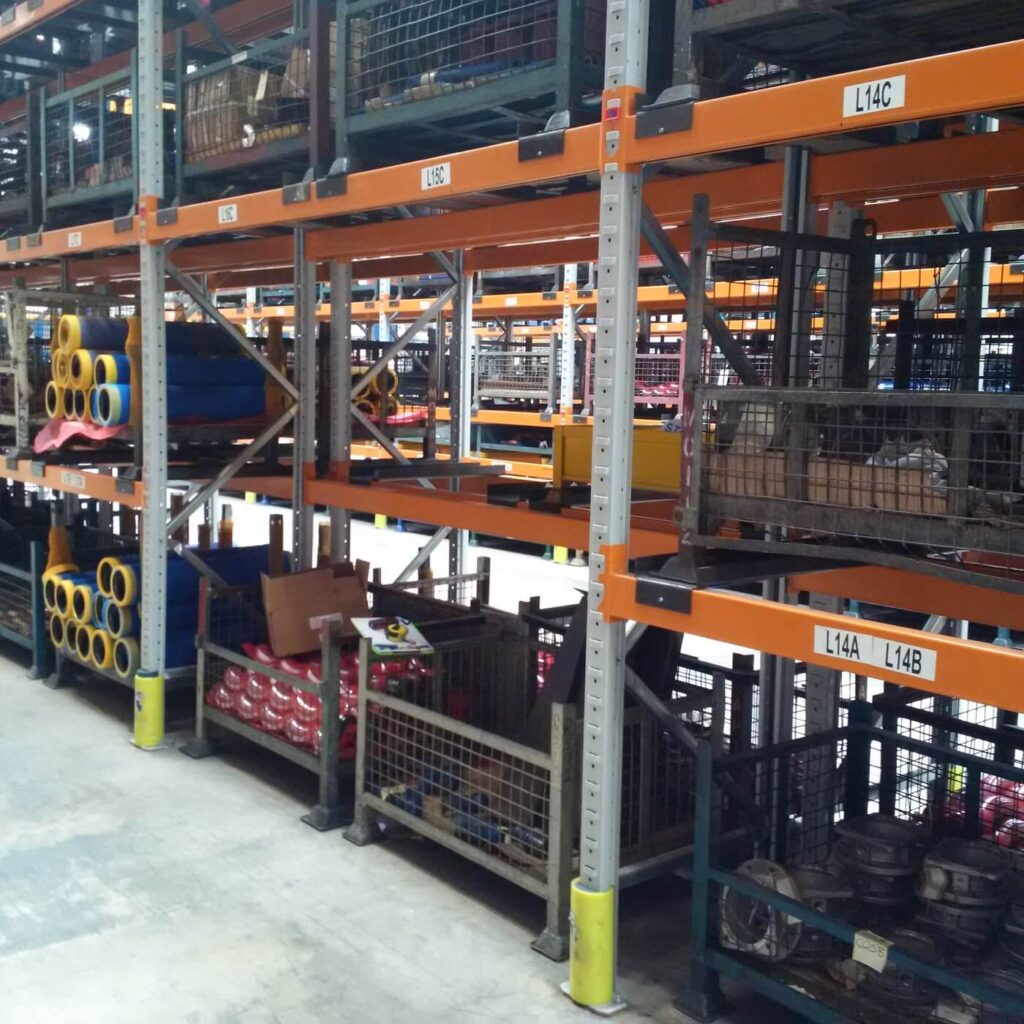
Ideal for heavy-duty applications such as automotive or industrial components, metal stillages are often completely custom made for a specific product and may not follow any standard sizing. A metal stillage provides a robust platform and may include barriers on all four sides (generally mesh or steel bars), to either form a secure cage that keeps goods contained or to trap items that would roll off pallets (such as tubing). This option is fire-resistant and exceptionally hard-wearing, though they are also the costliest pallet type.
Pallet Collars or mesh surrounds can be fitted to wood and plastic pallets to create a similar cage effect for less heavy duty applications.
Impact on pallet racking design
- Capable of high load capacity which will influence the racking design: stillages planned to be used with lighter goods can be very easily overloaded past their intended limit without any visible signs of strain, and this should be taken into account with the loading safety factor used in the design of the pallet racking.
- Can rest upon feet or skids. Your pallet racking will have to take the location of the feet into account (such as a custom frame depth) as a ‘pallet overhang’ (50 mm as standard under SEMA) should not be used. For lighter weight stillages, especially for taller racks which are harder to accurately load, PSBs can be used to widen the acceptable margin of error for the MHE operator depositing the stillage into the racks.
- No moisture absorption or warping, reducing concerns about degradation or dimensional instability.
- Fire resistant material makes it ideal in environments with restrictions of flammable goods, although the racking design must still comply with your site’s fire management strategy (allowing smoke ventilation or heat transfer to sprinklers and sufficient distance to sprinkler heads to allow the required water throw).
- Potential for rack damage if dropped or slammed. Metal on metal can cause impact wear, however, reinforced beam edges or protectors can minimise such risks.
- Stackable stillages requires extra vertical clearance in racking.
Metal stillages and racking types
When it comes to storing metal stillages, some pallet racking types may be the better option over others…
- Standard/wide aisle racking is a versatile option, offering great access to heavy-duty loads and is especially suitable for individual metal stillages carrying industrial or automotive parts. To support the weight, reinforced beams, PSBs, or decking may be needed. The flexibility of wide aisle racking makes it easy to store non-standard products or stillages with product overhang past the base of the stillage. For wider products stored on the stillage, the racking aisle will have to be made larger to allow room to manoeuvre.
- Double deep racking would be unsuitable for storing stillages as the accurate placement required would make the locations at the rear difficult to load.
- Drive-in or drive-through racking provides high-density storage and works well with consistently sized storage units, which can be a problem when looking to store stillages: if the stillage uses feet rather than skids to sit upon the storage rails, then the point-load imposed by the feet will have to be considered in the racking design, as this will be higher than that of a conventional wooden or plastic pallet (assuming that the unit stored is not extremely lightweight). Drive-in or drive-through should also only be considered if you have very consistent stillage sizes and a high quantity of the same product.
- Pallet-live and push-back racking should be used with caution as metal stillages may damage roller systems due to their weight and sharp edges unless the system is specially designed with reinforced tracks. As with the drive-in racks, any stillages that rest upon feet rather than skids are unlikely to be suitable for storage on a roller system.
Cardboard Pallets
This is a lightweight alternative, ideal for light products and are highly sustainable due to recyclability. Cardboard pallets can help minimise transportation costs because as a lighter load, fuel consumption is reduced.
Size Differences: Regional and industrial standards and custom sizes
The size of a pallet can vary according to industry, region and application. In the UK the most common standard sizes include the ‘UK’ 1200mm x 1000mm and the ‘Euro’ 1200mm x 800mm. In some facilities where goods are imported or exported, international pallet sizes may also be in use such as the North American standard size 1219mm x 1016mm or the Australia standard size 1165mm x 1165mm amongst others. Beyond regional standard sizes, some facilities operate using custom sized pallets, tailored to accommodate specific loads.

Impact on racking design
- Pallet Width/Depth: Dictates the beam length and frame depth which are adjusted so that the pallet sits securely on the beams and has enough space left-to-right to be loaded and unloaded without knocking other pallets without leaving too much room which would waste floor space
- Pallet Height: Impacts vertical clearance between levels
- Weight Per Pallet: Determines beam capacity and upright rating
- Overhang Tolerances: Influences aisle spaces and fire safety compliance
- Handling Equipment: Forklift reach/type must align with both pallet and racking size and have sufficient lifting capacity for the weight of your products.
Design differences: Two-Way Entry vs Four-Way Entry
Pallet entry points are the openings or spaces on a pallet that allow the tines (or ‘lifting prongs’) of a forklift truck to enter the pallet before lifting and moving it. These entry points are located on the sides of the pallet, beneath the deck and are formed by the design of the deck boards, stringers or block supports depending on the construction type.
There are two entry types as illustrated in the diagram:

- Two-way pallets have entry points at two opposite sides only
Impact on pallet racking design
- Limits racking design as the orientation of accessing or depositing the pallet is fixed. Reducing the flexibility for designing the layout of a pallet racking system.
- Typically requires more aisle space for access as the open face of a 2 way pallet is often on the shorter edge. This means that the pallet is deposited depth-ways into the racks and presents a longer load requiring more room to manoeuvre.
- The racking will be fixed into using a deeper frame to allow for storing this longer load. A racking design for a 4 way pallet can store on either the shorter or longer side of the pallet.
- In lane storage systems (such as drive-in, pallet live, and shuttle racks), 2 way pallets are less efficient as goal with designing these systems is to minimise the length of each lane to reduce cost per unit stored. 2 way pallets can generally only be accessed on the short face of the pallet meaning that the longer side of the pallet will be stacked up in the depth of the lane, making them longer and requiring additional material.
- Four-way pallets have entry points at all four sides
Impact on pallet racking design
- Greater flexibility in warehouse flow and forklift access: pallets can be lifted from both sides meaning that the racking system can be designed for either storage / access on the short or long face of the pallet which is useful in environments with limited space.
- Can enable narrower aisles in some layouts when the pallet is accessed on the longer face. Aisles for pallets in this orientation can be up to 200 mm narrower when using UK pallets.
- Can speed up material handling and reduce processing time as the pallet can be picked up and deposited from either side meaning that P&D (‘Pick-Up and Deposit’) stations can used with a VNA system for instance.
- Suitable for drive-in, standard, pallet live / roller and double deep racking systems.

Why Pallets Differ: Industry Demands and Supply Chain
Aside from regional differences, the variability in pallet types arise from different industry requirements, environmental factors and supply chain logistics. For example:
- Food and Beverage: Demands high hygiene, so plastic or treated wood pallets are preferred.
- Heavy Manufacturing: Requires robust pallets that can withstand substantial weights, therefore stillages or low collared pallets are often chosen ahead of other options.
- Retail Distribution: Involves standard-sized pallets for compatibility across multiple supply chain partners. This may sometimes demand multiple pallet sizes. The racking can either be designed in sections for different pallet sizes, or a you can use a pallet inverter to swap the non-standard pallet out for a pallet compatible with your racking.
These industry-specific needs dictate the kind of pallet in circulation which will then influence the pallet racking design

Pallet Orientation: Why it matters more than you think
The term ‘Pallet Orientation’ is used to refer to the side on which a pallet is accessed. For rectangular pallets (with a long and a short side) we use the term ‘access’ to describe whether the pallet is picked up from the long or short side. For a standard UK pallet, for instance, the long face would be the 1200mm side and the short face would be the 1000mm side. A UK pallet stored on pallet racking and ‘accessed on the 1000mm face’ would mean that the pallet is picked up on the 1000mm face and stored 1200mm deep (which would require an 1100mm deep racking frame).
Pallet orientation may seem like a small deal, but it plays a critical role in both logistics efficiency and pallet racking design. Getting it right can save costs, improve warehouse flow, and maximise transport capacity.
Maximise HGV Capacity: Transport costs are a key concern for any business. The more pallets you can fit into a single journey, the more efficient and cost-effective your logistics become.
A standard UK HGV trailer is 13.6 metres long and can carry:
- Up to 26 UK pallets
- Or 33 Euro pallets
This capacity depends heavily on how pallets are loaded. Correct orientation and pallet type can ensure every inch of the space is used effectively.
Alignment with HGV offloading methods: Once a loaded HGV arrives at its destination, the way pallets are offloaded depend on how they were loaded and their orientation.
Side loading and offloading (curtain side trucks)
- Pallets are both loaded and removed from the side of the trailer
- This setup typically requires the pallets to be loaded originally from the side of the trailer and offloaded in the same way
- A 2 way pallet is suitable for this style of loading/ offloading as the pallet face used for access at each end of the delivery will be the same though a 4-way pallet can also be used
Rear loading and offloading (shipping container style access)
- Pallets are both loaded and removed from the rear of the trailer using a dock leveller
- The forklift drives straight into the trailer, picks up the pallet, and then reverses out. A pallet pump-truck may also be used.
- A 2 way pallet is suitable for this style of loading/ offloading as the pallet face used for access at each end of the delivery will be the same though a 4-way pallet can also be used
Mixed loading and offloading (dock access)
- Sometimes for products stored on the pallet with no overhang over the pallet base, the goods can loaded and unloaded in either manner.
- A dock leveller is required for access through the back of the trailer. A 4-way entry pallet is required for this method.
- The reason that pallet overhang is an obstacle when changing the orientation of pallet access between loading and unloading is that a pallet overhang when loading the pallet through the side of the trailer may end up blocking access the pallet through the back of the trailer and vice versa.
From trailer to racking
After offloading, the next step is placing the pallets onto the racking system and orientation matters here too. If the orientation from the truck doesn’t match the racking orientation, the pallet will need to be placed onto the floor, before the truck makes its way to the correct entry side to pick it up again and load it onto the racks. This is only possible with a 4-way pallet.
For warehouses using Pick & Deposit Stations (P&Ds), the pallets entry points are especially important. Here’s how it varies, depending on the type of P&Ds:
Cantilevered Pick & Deposit Stations
- Found at the end of racking aisles with very narrow aisle (VNA) systems.
- Counterbalance forklifts unload the trailer, accessing the pallet using the longer side, and place this onto P&Ds that protrude out of the end of the racking runs.
- VNA trucks, operating only within the narrow aisles then pick the pallet from the P&D using the shorter face.
- In just two actions, the pallet is rotated from the shipping orientation into the storage orientation.
- To support both forklift and VNA truck access to the pallet, 4-way entry pallets are required.

Castellated Pick and Deposit Stations
- Found in VNA systems designed to have alternating long and short racking runs.
- End bays of longer rows act as P&D stations which can be accessed by both the counterbalance truck and the VNA truck.
- Counterbalance trucks deposit pallets and VNA trucks pick them up from the same face.
- This layout supports 2-way pallets, offering greater flexibility (though 4 way pallets can also be used)

Load Capacity and Safety Considerations
- The material and weight bearing capacity of pallets will directly influence the strength and specification of the pallet racking system.
- Overloading due to a misjudgement of pallet weight can compromise safety and structural integrity. This would require pallet weight labels applied by the supplier or the use of weigh scales (either stand alone or fitted to the truck forks) at the offloading end to confirm suitable pallet weight.
Beam and Frame Specifications
- Beam length must correspond with pallet width and loading patterns. The most common beam length is 2700mm and with 900mm deep frames, can store two UK pallets per bay. If your pallets are euro, the same beam length can support three pallets per bay with 1100mm deep frames.
- Beam positioning is influenced by the pallet depth and the bottom board configuration.
- The flue opening between the back-to-back beams should allow sufficient airflow and sprinkler water penetration (should sprinklers be required) whilst factoring in the pallet size for any overhang.
Location spacing refers to the clearance between:
- Pallet or load and upright
- Adjacent pallets or loads
- Underside of beam and top of pallet or load
The level of clearance required will depend on beam height. The diagram and table below shows the correct clearance for each, in accordance to SEMA guidelines.

Space Optimisation
The pallet size and type will influence the ability to optimise space. When using pallets with smaller dimension such as the euro pallet, you can store more pallets in a single bay of a static racking structure than you could if you were using the UK standard size, however the UK standard size has the potential to hold more weight, and therefore more product units per pallet.
With uniform pallets, placement is quick and straightforward with the space between each pallet being naturally equal.
Custom sized pallets are a great option for unusual loads, providing the pallet racking structure is designed to fit the custom sizes through bespoke dimensions or appropriate accessories such as mesh decks or support bars.
Material Handling Compatibility
Whilst most pallet types and forklift trucks are generally compatible with one other, size, weight or individual features of the pallets may require a specific type of forklift truck or demand appropriate accessories or modifications to the truck. A pallet of unique dimensions for example, may only be handled safely and efficiently if the truck has been modified or purposely built to do so. Lifting capacity must also be considered to ensure both weight and height can be handled safely. For any non-standard entry points or distinctive features, the forklift may need to be modified to suit, as an example, longer forks.

General Operating Conditions
Pallets in poor condition due to repeated use, incorrect loading or poor construction pose a real threat to health and safety. A pallet which suffers breakage, particularly at height where there is a risk of falling debris which can cause harm to any persons nearby or to the racking structure. It’s important to ensure that pallets are checked for potential weaknesses or damage on a regular basis.
Need Pallet Racking Advice? WSL makes it Easy!
No matter what type of pallets your operation uses, if you’re planning to install a new racking system, WSL is here to help. With decades of experience in designing and delivering tailored pallet racking solutions, our expert Technical Designers and Project Managers have you covered.
As an Approved Manufacturer Full Member of SEMA (the Storage Equipment Manufacturer’s Association), we guarantee the highest standards of quality and safety in every project.
Call our team today on 0113 2045350 or email sales@wslmail.co.uk